Thursday, February 18, 2016

The Shemitah Reset

As we are already at 35% unemployment  - real numbers, see county figures by state, not that FED lie BS. And at real inflation running around 8%. Negative interest rates plus a ban on cash so no one tries to save their wealth from Bank asset seizure, which is already happening everywhere. This Shemitah is the big one. The 70th 7th. 

FAMILY GUY PREDICTS DEATH OF ANTONIN SCALIA SUPREME COURT JUSTICE

Obligated to follow the Constitution? Yes you are. When will you start?

dooky in chief

1/2 inch of rain in Ojai, ca

highest rainfall in sierras since 2005, but they still play the drought card like we've had no rainfall at all, ever.

Jews Rebuilding The Temple

‘5 horrible years’: Libya marks 5th anniversary of NATO-backed uprising ...


when nato invokes regime change, the country turns into a violent cesspool of murderers and no economy.

Saturday, February 13, 2016

In the Spirit of Valentine's Day... Walgreens. W i...

The Open Scroll Blog: In the Spirit of Valentine's Day... Walgreens. W i...: 16 “Now no one after lighting a lamp covers it over with a container, or puts it under a bed; but he puts it on a lamp stand, so that those w...

This is what a country looks like after the USA goes in to "help" its people with a regime change. Which just means stealing their wealth and bombing them back into the stone age. These pics are the same all over, Iraq, Lebanon, Libya, Syria, Afghantistan, et al

Autocracy:

Democracy:

Autocracy:

Democracy:

Autocracy:

Democracy:

Autocracy:

Democracy:

Autocracy:

Democracy:

"Yes we can"... destroy the entire Middle East...
Window dressing dookey boy

Samsung Warns Customers To Think Twice About What They Say Near Smart TVs

Source: Jake Anderson

In a troubling new development in the domestic consumer surveillance debate, an investigation into Samsung Smart TVs has revealed that user voice commands are recorded, stored, and transmitted to a third party. The company even warns customers not to discuss personal or sensitive information within earshot of the device.
This is in stark contrast to previous claims by tech manufacturers, like Playstation, who vehemently deny their devices record personal information, despite evidence to the contrary, including news that hackers can gain access to unencrypted streams of credit card information.
The new Samsung controversy stems from the discovery of a single haunting statement in the company’s “privacy policy,” which states:
“Please be aware that if your spoken words include personal or other sensitive information, that information will be among the data captured and transmitted to a third party.”
This sparked a back and forth between the Daily Beast and Samsung regarding not only consumer privacy but also security concerns. If our conversations are “captured and transmitted,” eavesdropping hackers may be able to use our “personal or other sensitive information” for identity theft or any number of nefarious purposes.
There is also the concern that such information could be turned over to law enforcement or government agencies. With the revelation of the PRISM program — by which the NSA collected data from Microsoft, Google, and Facebook — and other such NSA spying programs, neither the government nor the private sector has the benefit of the doubt in claiming tech companies are not conscripted into divulging sensitive consumer info under the auspices of national security.
Michael Price, counsel in the Liberty and National Security Program at the Brennan Center for Justice at the NYU School of Law, stated:
“I do not doubt that this data is important to providing customized content and convenience, but it is also incredibly personal, constitutionally protected information that should not be for sale to advertisers and should require a warrant for law enforcement to access.”
Responding to the controversy, Samsung updated its privacy policy, named its third party partner, and issued the following statement:
“Voice recognition, which allows the user to control the TV using voice commands, is a Samsung Smart TV feature, which can be activated or deactivated by the user. The TV owner can also disconnect the TV from the Wi-Fi network.”
Under still more pressure, Samsung named its third party affiliate, Nuance Communications. In a statement to Anti-Media, Nuance said:
“Samsung is a Nuance customer. The data that Nuance collects is speech data. Nuance respects the privacy of its users in its use of speech data. Our use of such data is for the development and improvement of our voice recognition and natural language understanding technologies. As outlined in our privacy policy, third parties work under contract with Nuance, pursuant to confidentiality agreements, to help Nuance tailor and deliver the speech recognition and natural language service, and to help Nuance develop, tune, enhance, and improve its products and services.
“We do not sell that speech data for marketing or advertising. Nuance does not have a relationship with government agencies to turn over consumer data…..There is no intention to trace these samples to specific people or users.”
Nuance’s Wikipedia page mentions that the company maintains a small division for government and military system development, but that is not confirmed at this time.
Despite protestations from these companies that our voice command data is not being traced to specific users or, worse, stored for use by government or law enforcement agencies, it seems that when it comes to constitutional civil liberties, the end zone keeps getting pushed further and further down the field.
For years, technologists and smart device enthusiasts claimed webcam and voice recording devices did not store our information. While Samsung may be telling the truth about the use of that data, there are countless companies integrating smart technology who may not be using proper encryption methods and may have varying contractual obligations to government or law enforcement.

Is it really safe for us to assume that the now exceedingly evident symbiotic relationship between multinational corporations and government agencies does not still include a revolving door for the sharing of sensitive consumer data?

Wednesday, February 10, 2016

Twitter Recruits Crazed Feminist to Police Free Speech

There has been a big push since New Years in the Financial circles for a cashless society, the cover story being Negative interest rates or NIRP. It's a LIE. It's all about TOTAL CONTROL OVER THE PERSON, forcing them to do anything they wish IN ORDER TO BUY AND SELL. JUST LIKE REVELATIONS IN THE BIBLE HAS SAID.

That's right. All the cover stories and lies being told in the Wall street Journal, Financial Times, Bloomberg, etc, is all Network BS to cover the REAL MOTIVE. None shall buy or sell, without government approval.

Criticize the government, they turn off your number.

Protest fascist agendas, they turn off your number.

Be an individual,  they turn off your number.

Think for yourself,  they turn off your number.

Expose Fukushima, chemtrails, satanism, et al, they turn off your number.

Disagree with Social Justice fascism in all its flavors, they turn off your number.

Do anything, anytime, anywhere, THEY DON'T LIKE and,  they turn off your number.

When they turn off your number, or card, then with cash banned, you cannot buy or sell, pay bills, or engage in any kind of commerce.

The Beast System is hard by the door. And all these articles and such are just mental public conditioning to get people's minds ready for Orwellian nightmare they have planned for us.


Tuesday, February 9, 2016

Negative Interest Rates Aimed at Driving Small Banks Out of Business and Eliminating Cash

More than one-fifth of the world’s total GDP is in countries which have imposed negative interest rates, including Japan, the EU, Denmark, Switzerland and Sweden.
Negative interest rates are spreading worldwide.
And yet negative interest rates – supposed to help economies recover – haven’t prevented Japan and Europe’s economies from absolutely going down the drain.
Nor have they even stimulated spending. As ValueWalk points out:
Japan has had ultra-low rates for years and its economy has been terrible. Trillions of debt in Europe now trades at negative interest rates and its economy isn’t exactly booming.  Denmark, Sweden and Switzerland all have negative interest rates, but consumer spending isn’t going up there. In fact, savings rates have been going up in lockstep with the decrease in interest rates, exactly the opposite of what the geniuses at the various central banks expected.

Why is this happening? Simply, savers are scared. Lower interest rates have wrecked their retirement plans. Say you were doing some financial planning 10 years ago and plugged in 3% from your savings account.  Now its 0%.  You still have to plan for your retirement. Plug in 0%. What happens to your planning now?  0% compounded for X years is 0%.  The math is simple. So in order to have your target savings at retirement, you need to save more, not spend more. But for some reason, the economists that run central banks around the world can’t see this. They are all stuck in their offices talking to one another and self-reinforcing this myth that they can drive spending up by reducing the rate of return on investments.  Want to see consumer spending go up?  Don’t wreck their savings plans so that they are too scared to spend.  But that’s too simple. Instead, central banks use a chain of causation that doesn’t exist to try to create change 3 or 4 steps down the line. It hasn’t worked, and it won’t work. It isn’t in an individual’s self-interest to go out and spend their money on more “stuff” in order to spur economic growth.
So what’s really going on? Why are central banks worldwide pushing negative interest rates?
Economics professor Richard Werner – the creator of quantitative easing – notes:
The experience of Switzerland [shows that] negative rates raise banks’ costs of doing business. The banks respond by passing on this cost to their customers. Due to the already zero deposit rates, this means banks will raise their lending rates. As they did in Switzerland. In other words, reducing interest rates into negative territory will raise borrowing costs!

If this is the result, why do central banks not simply raise interest rates? This would achieve the same result, one might think. However, there is a crucial difference: raised rates will allow banks to widen their interest margin and make their business more profitable. With negative rates, banks’ margins will stay low and the financial situation of the banks will stay precarious and indeed become ever more precarious.

As readers know, we have been arguing that the ECB has been waging war on the ‘good’ banks in the eurozone, the several thousand small community banks, mainly in Germany, which are operated not for profit, but for co-operative members or the public good (such as the Sparkassen public savings banks or the Volksbank people’s banks). The ECB and the EU have significantly increased regulatory reporting burdens, thus personnel costs, so that many community banks are forced to merge, while having to close down many branches. This has been coupled with the ECB’s policy of flattening the yield curve (lowering short rates and also pushing down long rates via so-called ‘quantitative easing’). As a result banks that mainly engage in traditional banking, i.e. lending to firms for investment, have come under major pressure, while this type of ‘QE’ has produced profits for those large financial institutions engaged mainly in financial speculation and its funding.

The policy of negative interest rates is thus consistent with the agenda to drive small banks out of business and consolidate banking sectors in industrialised countries, increasing concentration and control in the banking sector.

It also serves to provide a (false) further justification for abolishing cash. And this fits into the Bank of England’s surprising recent discovery that the money supply is created by banks through their action of granting loans: by supporting monetary reformers, the Bank of England may further increase its own power and accelerate the drive to concentrate the banking system if bank credit creation was abolished and there was only one true bank left – the Bank of England. This would not only get us back to the old monopoly situation imposed in 1694 when the Bank of England was founded as a for-profit enterprise by private profiteers. It would also further the project to increase control over and monitoring of the population: with both cash and bank credit alternatives abolished, all transactions, money creation and allocation would be implemented by the Bank of England.
If this sounds like a “conspiracy theory”, the Financial Times argued in 2014 that central banks would be the real winners from a cashless society:
Central bankers, after all, have had an explicit interest in introducing e-money from the moment the global financial crisis began…

***

The introduction of a cashless society empowers central banks greatly. A cashless society, after all, not only makes things like negative interest rates possible, it transfers absolute control of the money supply to the central bank, mostly by turning it into a universal banker that competes directly with private banks for public deposits. All digital deposits become base money.

 http://www.zerohedge.com/news/2016-02-09/economics-professor-negative-interest-rates-aimed-driving-small-banks-out-business-a

Saturday, February 6, 2016

Gold...

We are certainly seeing what we've expected. And yes, silver is simply slightly tracking gold, because as a PM, that's the way. For me, it's about keying into the contango of the futures. For those who got in at the dead lows of December 2015, on minimal premiums, usually under 30 dollars US per ounce, selling in mid to late February and then reacquiring after the inevitable correction once backwardation has run its course, is the smarter play. Short term gains are realized, whilst positioning one's self for further acquisitions after correction. Will gold peak in late February or march? keep an eye on the futures market. Keep an eye on the dollar and its technicals. In this manner one can appreciate earnings and continue to and prepare for, new purchases at reduced prices once this has run its course.

Still stand by the lower prices of gold and silver for the year, especially in summer and late fall. The last thing to do is buy high on the run-up, AFTER it has broken its 50, 200, and multiyear moving average, which gold has already done. Or, as many do, screw profits. Just hold and damn the losses against current price in futures terms against past entrance price points. For many, that's the plan...acquire and hold. Fine. Then you miss profit taking. Pay off some bills, etc.

Currencies die, true inflation above 8%, gold serves and protects

Facebook's War On Freedom Of Speech

Zuckerberg was honored at the CIA and in their circles, his code name is OVERLORD. Guess what facebook is really a front for?
  • Facebook is now removing speech that presumably almost everybody might decide is racist -- along with speech that only someone at Facebook decides is "racist."
  • The sinister reality of a society in which the expression of majority opinion is being turned into a crime has already been seen across Europe. Just last week came reports of Dutch citizens being visited by the police and warned about posting anti-mass-immigration sentiments on social media.
  • In lieu of violence, speech is one of the best ways for people to vent their feelings and frustrations. Remove the right to speak about your frustrations and only violence is left.
  • The lid is being put on the pressure cooker at precisely the moment that the heat is being turned up. A true "initiative for civil courage" would explain to both Merkel and Zuckerberg that their policy can have only one possible result.
It was only a few weeks ago that Facebook was forced to back down when caught permitting anti-Israel postings, but censoring equivalent anti-Palestinian postings.
Now one of the most sinister stories of the past year was hardly even reported. In September, German Chancellor Angela Merkel met Mark Zuckerberg of Facebook at a UN development summit in New York. As they sat down, Chancellor Merkel's microphone, still on, recorded Merkel asking Zuckerberg what could be done to stop anti-immigration postings being written on Facebook. She asked if it was something he was working on, and he assured her it was.

 http://www.zerohedge.com/news/2016-02-05/facebooks-war-freedom-speech

The following map shows the spread of methane over the Los Angeles area and researchers from Eco Watch report that elevated levels of natural gas have been detected as far as 10 miles from the leak:

LA-leak
Been trying to warn people since early december 2015. they are reporting multiple fissures of gas now coming up through the mountain range. When and if this ever ignites...the people of SCV and SFV won't have a chance.

Wednesday, February 3, 2016

House prices finally head downward...like everything else

Capital fleeing real estate as investment for renters

Young American? No house for you, except as a rental
the student loan debt problem is a slightly bigger issue than affordable housing. Part of the reason housing is unaffordable is because of the large student loans people are paying off. If you have to pay $500-$1000 a month in student loans, even renting becomes difficult.

  College costs have risen to the stars under the Obama Administration, so the exiting student can now look forward to skyrocketing student loan payments. PhD’s and Master’s level students might qualify for those $100K annual salaries, but they are saddled with at least 1 1/2 years salary in debt (with Fed loans averaging 6 and 7% for the last few years.) Even if they made enough money to qualify for a loan, their student debt makes qualifying for a house in Cali nearly impossible.
They live at home because the reality of their situation demands it. They CAN’T qualify to buy a house, even if they WANT to. Just watch. The next financial crisis will be all those “irresponsible” student loan borrowers. Money at this point goes to paying everyone else and they still can’t afford to exist. Last time I checked, it was called slavery when everyone owned every dime you made and you ended up with zilch!

The secular trend to expansion of credit has morphed into contraction and liquidation

This is what the Federal Reserve did in the 1930s which actually created the Great Depression and they are now doing the exact same thing. Restrict credit, slow the velocity of money, and everything STOPS.

same old song and dance...that ends in widespread poverty

Tuesday, February 2, 2016

MINI NUKE Porter Ranch santa clarita aliso canyon

New video shows gas still spewing in Porter Ranch. “Very unusual” infect...

Cutting Through The Haze

The Daily Messenger: Cutting Through The Haze: By Don Bradley April 2009 We certainly live in interesting times. We live in a time where governments spray the skies with chemtrails, poiso...

Retail Apocalypse: 2016 Brings Empty Shelves And Store Closings All Across America

Major retailers in the United States are shutting down hundreds of stores, and shoppers are reporting alarmingly bare shelves in many retail locations that are still open all over the country.  It appears that the retail apocalypse that made so many headlines in 2015 has gone to an entirely new level as we enter 2016. 
As economic activity slows down and Internet retailers capture more of the market, brick and mortar retailers are cutting their losses.  This is especially true in areas that are on the lower portion of the income scale.  In impoverished urban centers all over the nation, it is not uncommon to find entire malls that have now been completely abandoned.  It has been estimated that there is about a billion square feet of retail space sitting empty in this country, and this crisis is only going to get worse as the retail apocalypse accelerates.
We always get a wave of store closings after the holiday shopping season, but this year has been particularly active.  The following are just a few of the big retailers that have already made major announcements…
-Wal-Mart is closing 269 stores, including 154 inside the United States.
-K-Mart is closing down more than two dozen stores over the next several months.
-J.C. Penney will be permanently shutting down 47 more stores after closing a total of 40 stores in 2015.
-Macy’s has decided that it needs to shutter 36 stores and lay off approximately 2,500 employees.
-The Gap is in the process of closing 175 stores in North America.
-Aeropostale is in the process of closing 84 stores all across America.
-Finish Line has announced that 150 stores will be shutting down over the next few years.
-Sears has shut down about 600 stores over the past year or so, but sales at the stores that remain open continue to fall precipitously.
But these store closings are only part of the story.
All over the country, shoppers are noticing bare shelves and alarmingly low inventory levels.  This is happening even at the largest and most prominent retailers.
I want to share with you an excerpt from a recent article by Jeremiah Johnson.  The anecdotes that he shares definitely set off alarm bells with me.  Read them for yourself and see what you think…
*****
I came across two excellent comments upon Steve Quayle’s website that bear reading, as these are two people with experience in retail marketing, inventory, ordering, and purchases.  Take a look at these:
#1 (From DJ, January 24, 2016)
“Steve-
[Regarding the] alerts about the current state of the RR industry. This is in line with what I’ve been noticing as I visited our local/regional grocery store, Walmart, and Target this week in WI. I worked in big box retail for 20 years specializing in Inventory Management. These stores are all using computerized inventory management systems that monitor and automatically replenish inventory when levels/shelf stock get low. This prevents “out of stocks” and lost sales. These companies rely on the ability to replenish inventory quickly from regional warehouses.

As I shopped this week and looked at inventory levels I was shocked. There were numerous (above and beyond acceptable levels) out of stocks across category lines at all three retailers.

And even where inventory was on the shelf, the overall levels were noticeably reduced. Based on my experience, working for two of these three organizations in store management, they have drastically/intentionally reduced their inventory levels. This is either due to financial stresses/poor sales effecting their ability to acquire new inventory, or it could be the result of what was mentioned earlier regarding the transporting of goods to these regional warehouses. Either way this doesn’t bode well for the what’s to come.  Stock up now while you can!”
#2 (From a Commenter following up #1 who didn’t provide a name, January 26, 2016)
“I’d like to tailgate on the SQ Alert “based on my experience…” regarding stock levels in big box stores. This weekend we were in two such stores, each in fairly isolated communities which are easily the communities’ best source for acquiring grocery items in quantity.

I myself worked in retail (meat) for thirty years so I know exactly what a well-stocked store looks like, understand the key categories and category drivers, and how shelves are stocked and displays are built to drive sales and profits. I also understand supply chain and distribution methodologies quite well.

Each of the stores we were in were woefully under-stocked. This time of year-the few weeks following the holidays-is usually big business in groceries and low stock levels suggest either poor ordering at the store level, poor purchasing at the distribution level or a purposeful desire to be under-stocked.

Anyone familiar with the retail grocery industry is also familiar with how highly touted “the big box store’s” infrastructure is. They know exactly when demand is high and for what items and in what quantities. It is very unlikely that both stores somehow got “surprised” by unusually high demand. It is reasonable then to imagine that low stock levels in rural areas with few options is a purposed endeavor to assure that both the budget conscious and the folks in more remote areas are not fully able to load up their pantries.

Simply put I believe the major retailer in question is doing their part to limit the ability of rural America to be sufficiently prepared. Nevertheless, we are wise to do our best to keep ahead of the curve. God bless your efforts, Steve.”
*****
Yes, this is just anecdotal evidence, but it lines up perfectly with hard numbers that we have been discussing.
Exports are plummeting all over the globe, and the Baltic Dry Index just plunged to another new all-time record low.  The amount of stuff being shipped around by air, truck and rail inside this country has been dropping significantly, and this tells us that real economic activity is really slowing down.
If you currently work in the retail industry, your job is not secure, and you may want to start evaluating your options.
We have entered the initial phases of a major economic downturn, and it is going to be especially cruel to those on the low end of the income spectrum.  Do what you can to get prepared now, because the economy is not going to be getting better any time soon.
 http://www.zerohedge.com/news/2016-02-02/retail-apocalypse-2016-brings-empty-shelves-and-store-closings-all-across-america

Friday, January 29, 2016

Robbery at the bank. customers fleeced, banks don't go to jail.

not only inflation steals our money, but the banks are getting in directly on the grab your cash bandwagon. Add asset seizure by law enforcement and every kind of tax imaginable, it's a miracle that wage earners can survive in this modern world.

Thursday, January 28, 2016

17-Year-Old Girl Fined For Pepper Spraying "Rapefugee" In "World's Best Country For Women"

On Wednesday, we brought you the tragic story of 22-year-old Alexandra Mezher, who was stabbed to death by a Somali migrant child in a Swedish asylum center for unaccompanied refugee children.
Mezher’s death served as a poignant reminder to the country’s politicians that the move to take in 163,000 asylum seekers fleeing the horrors of the Mid-East’s many proxy wars isn’t without risk.
The stabbing comes at a particularly delicate time for Swedish authorities. Earlier this month, Nyheter Idag released an investigative report alleging prominent Swedish daily Dagens Nyheter sought to conceal from the public a wave of sexual assaults at a youth festival and concert in central Stockholm’s Kungsträdgården last August.
Dagens Nyheter denied the allegations, saying it was in fact Swedish police that were responsible for the coverup.
Meanwhile, “gangs” of Moroccan migrant children have commandeered the main train station in Stockholm, where they plunder, grope, and otherwise wreak havoc upon helpless Swedes. Or something.
And it’s not just Sweden. There have been hundreds of reported sexual assaults across the bloc this month and so far, the “best” solution officials can come up with is a kind of blame the victim strategy articulated by Cologne mayor Henriette Reker who suggested that it is German women’s responsibility to keep themselves from getting raped by staying an “arm’s length” away from would-be attackers.
This week we got another example of officials effectively blaming the victim, this time in Denmark where a teenager who used pepper spray on an assailant will be fined for deploying an illegal substance.
The alleged attack occurred “near an asylum center” and according to the girl, was perpetrated by an “dark-skinned English speaking man who knocked her down and tried to undress her.”
“She was later warned by police that the pepper spray she used on him was illegal for private citizens to possess, and that she would face a £50 fine,” The Telegraph writes.
It is illegal to possess and use pepper spray, so she will likely to be charged for that,” a police spokesperson said.
"Numerous readers wrote in the comments section on TV Syd’s story about the incident that they would be willing to pay the girl’s fine," The Local says. "The man who attacked the 17-year-old fled from the scene and has not been charged."
According to the Copenhagen Post, more Danes are traveling to Germany to buy pepper spray than ever before.
“Sales have really exploded after the New Year and the attacks in Cologne,” an owner of a weapons store in the border town of Flensborg, said. “In January, we’ve had 50-60 percent more Danish customers than usual.”
You'll recall that pepper spray sales are off the charts in Germany since the attacks in Cologne on New Year's Eve as are Google searches for the weapon.

But don't be fooled says Anders Rasmussen, a prevention specialist at the Danish Crime Prevention Council, pepper spray may be used as a defensive weapon in some cases, but if legalized in Denmark, people will "quickly" start a non-lethal arms race with one another.
"Pepper sprays give a false sense of safety," Rasmussen told The Post. "They can also be used as an offensive weapon, which may quickly develop into a sort of armed competition between civilians."
Yes, "a sort of armed competition between civilians" who would presumably try to stockpile mace in a dangerous game of pepper spray one-upmanship. One commenter - a Frank Silbermann - is incredulous:

Good question, Frank.
We wonder if Rasmussen would point to 17-year-old girls' usage of pepper spray on would-be assailants as an example of how dangerous society can get once you allow "civilians" to carry mace.

http://www.zerohedge.com/news/2016-01-28/17-year-old-girl-fined-pepper-spraying-rapefugee-worlds-best-country-women

The Truth About 'Fat Shaming'

The Truth About Trans-Everything

Tuesday, January 26, 2016

the Why and What survives in finance during a major economic crash

The real business cycle and its called shemitah
only performing asset in any crash

best growth against any currency, gold

Saturday, January 23, 2016

local police announced that anyone using New York roads after that time will be arrested on the spot, like the vile criminal filth they are

IN AMERIKA, THE CITIZENS ARE THE ENEMY.

Congratulations New Yorkers: moments ago not only did your local authorities ban all travel starting at 2:30pm...
  • CUOMO: PORT AUTHORITY ISSUED TRAVEL BAN ON G. WASHINGTON BRIDGE
  • CUOMO: PORT AUTHORITY ISSUED BAN ON LINCOLN, HOLLAND TUNNELS
  • CUOMO: PORT AUTHORITY ISSUED BAN ON BAYONNE, GOETHALS BRIDGES
  • MTA TO SUSPEND LIRR, METRO-NORTH SERVICE AS OF 4PM
  • CUOMO: PORT AUTHORITY ISSUED BAN ON OUTERBRIDGE CROSSING
... but the local police announced that anyone using New York roads after that time will be arrested on the spot, like the vile criminal filth they are.

ObamaTrade Will Cost 448,000 American Jobs, New Study Finds

BUT THAT'S THE PLAN - TO TURN AMERICA INTO MEXICO. WITH ABJECT POVERTY AND HOPELESSNESS ON EVERY CORNER. TO CREATE A POLICE STATE OF VIOLENCE AND DRUG CARTELS AND ALL THAT ENSUES THE NEW NORMAL.


Submitted by Derrick Broze via TheAntiMedia.org,
One of the major purported selling points for the Trans-Pacific Partnership (TPP) is a supposed increase in new jobs as a result of the controversial trade deal. The deal involves 12 nations, including the U.S., Australia, Canada, New Zealand, Japan, Malaysia and more. However, two recent economic reports have contradicted the claims that jobs will increase. They have shown that, more than likely, the deal will lead to a loss of jobs.
First there was a World Bank report that predicted that TPP would produce negligible boosts to the economies of the U.S., Australia, and Canada. TechDirt writes:
So according to the World Bank’s figures, the U.S. will gain an extra 0.04% GDP per year on average, as a result of TPP; Australia an extra 0.07% annually, and Canada a boost of 0.12% per year.”
This study was followed up by a review from Jerome Capaldo and Alex Izurieta at Tufts University. In a study titled “Trading Down: Unemployment, Inequality and Other Risks of the Trans-Pacific Partnership Agreement,” Capaldo and Izurieta claim their study uses a more realistic model than past analyses. Specifically, the researchers state that their model incorporates effects on employment that were previously excluded from TPP calculations.
Their study found that economic growth is likely to be limited — and negative — for some countries, including the United States. The researchers also found the TPP would probably lead to increased unemployment and inequality. Capaldo and Izurieta explained:
“The standard model assumes full employment and invariant income distribution, ruling out the main risks of trade and financial liberalization. Subject to these assumptions, it finds positive effects on growth. An important question, therefore, is how this conclusion changes if those assumptions are dropped.”
In the paper, the two researchers state that changes in GDP growth are “mostly projected to be negligible. After using two sets of growth figures, ten-year measurements, and annual averages, they concluded the TPP “appears to only marginally change competitiveness among participating countries. Most gains are therefore obtained at the expense of non-TPP countries.”
The fact that any gains — however negligible — will come at the cost of non-TPP countries should be a warning to all nations of the world, especially those who do not stand to benefit from the agreement. Concerning predictions of actual job losses or gains, the researchers write,TPP would lead to employment losses in all countries, with a total of 771,000 lost jobs. The United States would be the hardest hit, with a loss of 448,000 jobs.
Finally, the researchers draw harrowing conclusions about the end result of the TPP.
“Globally, the TPP favors competition on labor costs and remuneration of capital. Depending on the policy choices in non-TPP countries, this may accelerate the global race to the bottom, increasing downward pressure on labor incomes in a quest for ever more elusive trade gains.”
This latest analysis of TPP job claims is even more dismal than a February 2015 analysis by the Washington Post, which revealed the U.S. government’s numbers on expected job increases from the TPP are not factually correct. The Post’s Fact Checker examined several quotes from government officials, including Secretary of State John Kerry and Secretary of Agriculture Tom Vilsack. Both Kerry and Vilsack claimed the international trade agreement would create 650,000 new jobs. However, these numbers do not take into account income gains and changing wages. According to the government’s own sources, imports and exports would increase by the same amount — resulting in a net number of zero new jobs.
The TPP has faced criticism for several years, not least because it has been negotiated in secret with overwhelming influence from multinational corporations. In late June 2015, President Obama signed into law the so-called “fast-track” bill, which set the stage for approval of the TPP. “Fast-track” limits Congress’ ability to alter the provisions of the trade deal, and only allows a vote of yes or no. The final terms of the deal were agreed upon in October 2015, and the full text of the agreement was released in November. The earliest Obama can sign the deal is February 4, 2016.
Following the release of the text of the TPP, journalist James Corbett released an excellent report examining the effects of the proposal. Corbett concludes that the most egregious portions relate to the Investor-State Dispute Settlement (ISDS) Mechanism, intellectual property, and food safety standards.
According to the report, ISDS will give corporations loopholes to escape accountability and empower international bodies, overriding the national sovereignty of signing nations. Under ISDS, foreign corporations would be allowed to appeal legal decisions to international tribunals, rather than face domestic courts. Critics fear this could lead to a loss of sovereignty and the enrichment of transnational corporations.
In late 2015, Anti-Media reported the TPP might not be voted on until after the 2016 presidential elections, or possibly into the next presidential term, according to Senate Majority Leader Mitch McConnell.
In an interview with the Washington Post, McConnell said he does not support the idea of voting on the TPP before the election. “It certainly shouldn’t come before the election. I don’t think so, and I have some serious problems with what I think it is,” he said. “But I think the president would be making a big mistake to try to have that voted on during the election. There’s significant pushback all over the place.”
We will continue working with Congressional leaders to pass the Trans-Pacific Partnership as soon as possible next year,” Brandi Hoffine, a White House spokeswoman, told the Post on Thursday. On Friday, White House Press Secretary Josh Earnest told reporters, “Our view is that it is possible for Congress to carefully consider the details of this agreement and to review all the benefits associated with this agreement … without kicking the vote all the way to the lame-duck period.”
Recently, the Electronic Frontier Foundation also released a report on the dangers of the TPP. EFF writes:
Everything in the TPP that increases corporate rights and interests is binding, whereas every provision that is meant to protect the public interest is non-binding and is susceptible to get bulldozed by efforts to protect corporations.”

The EFF’s report offers “a list of communities who were excluded from the TPP deliberation process,” and examples of “the main ways that the TPP’s copyright and digital policy provisions will negatively impact them.”
These communities include Innovators and Business Owners; Libraries, Archives, and Museums; Students; Impacts on Online Privacy and Digital Security; Website Owners; Gamers; Artists; Journalists and Whistleblowers; Tinkerers and Repairers; Free Software; and Cosplayers and Fans of Anime, Cartoons, or Movies.
Before the deal was signed, fifteen different organizations issued an open letter asking TPP negotiators to provide public safeguards for copyrighted works. These groups include Australian Digital Alliance, Consumer NZ (New Zealand), Copia Institute (United States), Creative Commons (International), Electronic Frontier Foundation (United States, Australia), Hiperderecho (Peru), Futuristech Info (International), Global Exchange (International), iFixit (International), New Media Rights (United States), ONG Derecho Digitales (Chile), Open Media (Canada), Public Citizen (United States), and Public Knowledge (United States).
The authors of the letter state copyright restricts important, everyday use of creative works. The groups call on the negotiators to be open to new changes that require participating nations to develop balanced and flexible rules on copyrights. Also highlighted in the letter are four key concerns from the organizations, including retroactive copyright term extension, a ban on circumvention of technology protection measures, “heavy-handed criminal penalties and civil damages,” and trade secret rules that could criminalize investigative journalism and whistleblowers reporting on corporate wrongdoing.
As the EFF writes, “Despite its earlier promises that the TPP would bring ‘greater balance’ to copyright more than any other recent trade agreement, the most recent leak of the Intellectual Property chapter belies their claims. The U.S. Trade Representative (USTR) has still failed to live up to its word that it would enshrine meaningful public rights to use copyrighted content in this agreement.”
The TPP is not only facing resistance from electronic privacy groups, but from grassroots activists and concerned professionals around the world. Both the Anglican and Catholic churches of New Zealand have demanded governments be more transparent about the negotiations. Radio NZ reports that bishops from the churches are concerned with the lack of openness. They are worried corporate interests are influencing the agreement while the people are excluded. The churches also called on the New Zealand government to make the draft text of the agreement public.
Doctors Without Borders released a statement following the conclusion of negotiations:
Doctors Without Borders/Médecins Sans Frontières (MSF) expresses its dismay that TPP countries have agreed to United States government and multinational drug company demands that will raise the price of medicines for millions by unnecessarily extending monopolies and further delaying price-lowering generic competition. The big losers in the TPP are patients and treatment providers in developing countries. Although the text has improved over the initial demands, the TPP will still go down in history as the worst trade agreement for access to medicines in developing countries, which will be forced to change their laws to incorporate abusive intellectual property protections for pharmaceutical companies.
In early February 2015, doctors and health professionals representing seven countries released a letter warning the TPP will lead to higher medical costs for all nations. The letter, published in the Lancet Medical Journal, states, Rising medicine costs would disproportionately affect already vulnerable populations. Those doctors called on the governments involved in the trade deal to publicly release the full text of the agreement. They also demanded an independent analysis of the effects on health and human rights for each nation involved in the deal.

Wednesday, January 20, 2016

Economies are falling because demand is falling. Demand is falling because Americans are not buying. Americans are not buying because Americans are broke. Americans are broke because central bank policy has created an environment of wealth destruction.

Anyone who attempts to dismiss the dangers of a U.S. breakdown or the threat to the unprepared public is either an idiot, or they are trying to divert and distract you from reality. The coming months will undoubtedly verify this.

The U.S. Is At The Center Of The Global Economic Meltdown

Submitted by Brandon Smith via Alt-Market.com,
While the economic implosion progresses this year, there will be considerable misdirection and disinformation as to the true nature of what is taking place. As I have outlined in the past, the masses were so ill informed by the mainstream media during the Great Depression that most people had no idea they were actually in the midst of an “official” depression until years after it began. The chorus of economic journalists of the day made sure to argue consistently that recovery was “right around the corner.” Our current depression has been no different, but something is about to change.
Unlike the Great Depression, social crisis will eventually eclipse economic crisis in the U.S. That is to say, our society today is so unequipped to deal with a financial collapse that the event will inevitably trigger cultural upheaval and violent internal conflict. In the 1930s, nearly 50% of the American population was rural. Farmers made up 21% of the labor force. Today, only 20% of the population is rural. Less than 2% work in farming and agriculture. That’s a rather dramatic shift from a more independent and knowledgeable land-utilizing society to a far more helpless and hapless consumer-based system.
What’s the bottom line? About 80% of the current population in the U.S. is more than likely inexperienced in any meaningful form of food production and self-reliance.
The rationale for lying to the public is certainly there. Economic and political officials could argue that to reveal the truth of our fiscal situation would result in utter panic and immediate social breakdown. When 80% of the citizenry is completely unprepared for a decline in the mainstream grid, a loss of savings through falling equities and a loss of buying power through currency destruction, their first response to such dangers would be predictably uncivilized.
Of course, the powers-that-be are not really interested in protecting the American people from themselves. They are interested only in positioning their own finances and resources in the most advantageous investments while using our loss and fear to extract more centralization, more control and more consent. Thus, the hiding of economic decline is enacted because the decline itself is useful to the elites.
And just to be clear for those who buy into the propaganda, the U.S. is indeed in a speedy decline.
In 'Lies You Will Hear As The Economic Collapse Progresses', published in summer of last year, I predicted that “Chinese contagion” would be used as the scapegoat for the downturn in order to hide the true source: American wealth destruction. Today, as the Dow and other markets plummet and oil markets tank due to falling demand and glut inventories, all we seem to hear from the mainstream talking heads and the people who parrot them in various forums is that the U.S. is the “only stable economy by comparison” and the rest of the world (mainly China) is a poison to our otherwise exemplary financial health. This is delusional fiction.
The U.S. is the No. 1 consumer market in the world with a 29% overall share and a 21% share in energy usage, despite having only 5 percent of the world’s total population. If there is a global slowdown in consumption, manufacturing, exports and imports, then the first place to look should be America.
Trucking freight in the U.S. is in steep decline, with freight companies pointing to a “glut in inventories” and a fall in demand as the culprit.
Morgan Stanley’s freight transportation update indicates a collapse in freight demand worse than that seen during 2009.
The Baltic Dry Index, a measure of global freight rates and thus a measure of global demand for shipping of raw materials, has collapsed to even more dismal historic lows. Hucksters in the mainstream continue to push the lie that the fall in the BDI is due to an “overabundance of new ships.” However, the CEO of A.P. Moeller-Maersk, the world’s largest shipping line, put that nonsense to rest when he admitted in November that “global growth is slowing down” and “[t]rade is currently significantly weaker than it normally would be under the growth forecasts we see.”
Maersk ties the decline in global shipping to a FALL IN DEMAND, not an increase in shipping fleets.
This point is driven home when one examines the real-time MarineTraffic map, which tracks all cargo ships around the world. For the past few weeks, the map has remained almost completely inactive with the vast majority of the world’s cargo ships sitting idle in port, not traveling across oceans to deliver goods. The reality is, global demand has fallen down a black hole, and the U.S. is at the top of the list in terms of crashing consumer markets.
To drive the point home even further, the U.S. is by far the world’s largest petroleum consumer. Therefore, any sizable collapse in global oil demand would have to be predicated in large part on a fall in American consumption. Oil inventories are now overflowing, indicating an unheard-of crash in energy use and purchasing.
U.S. petroleum consumption was actually lower in 2014 than it was in 1997 and 25% lower than earlier projections predicted. A large part of this reduction in gas use has been attributed to fewer vehicle miles traveled. Though oil markets have seen massive price cuts, the lack of demand continued through 2015.
This collapse in consumption is reflected partially in newly adjusted 4th quarter GDP forecasts by the Federal Reserve, which are now slashed down to 0.7%.  And remember, Fed and government calculate GDP stats by counting government spending of taxpayer money as "production" or "commerce".  They also count parasitic programs like Obamacare towards GDP as well.  If one were to remove government spending of taxpayer funds from the equation, real GDP would be far in the negative.  That is to say, if the fake numbers are this bad, then the real numbers must be horrendous.
And finally, let’s talk about Wal-Mart. There is a good reason why mainstream pundits are attempting to marginalize Wal-Mart’s sudden announcement of 269 store closures, 154 of them within the U.S. with at least 10,000 employees being laid off. Admitting weakness in Wal-Mart means admitting weakness in the U.S. economy, and they don’t want to do that.
Wal-Mart is America’s largest retailer and largest employer. In 2014, Wal-Mart announced a sweeping plan to essentially crush neighborhood grocery markets with its Wal-Mart Express stores, building hundreds within months. Today, those Wal-Mart Express stores are being shut down in droves, along with some supercenters. Their top business model lasted around a year before it was abandoned.
Some in the mainstream argue that this is not necessarily a sign of economic decline because Wal-Mart claims it will be building 200 to 240 new stores worldwide by 2017. This is interesting to me because Wal-Mart just suffered its steepest stock drop in 27 years on reports that projected sales will fall by 6% to 12% for the next two years.
It would seem to me highly unlikely that Wal-Mart would close 154 stores in the U.S. (269 stores worldwide) and then open 240 other stores during a projected steep crash in sales that caused the worst stock trend in the company’s history. I think it far more likely that Wal-Mart executives are attempting to appease shareholders with expansion promises they do not plan to keep.
I am going to call it here and now and predict that most of these store sites will never see construction and that Wal-Mart will continue to make cuts, either with store closings, employee layoffs or both.
As the above data indicates, global demand is disintegrating; and the U.S. is a core driver.
The best way to sweep all these negative indicators under the rug is to fabricate some grand idea of outside threats and fiscal dominoes. It is much easier for Americans to believe our country is being battered from without rather than destroyed from within.
Does China have considerable fiscal issues including debt bubble issues? Absolutely. Is this a catalyst for global collapse? No. China’s problems are many but if there is a first “domino” in the chain, then the U.S. economy claims that distinction.
China is the largest exporter in the world, not the largest consumer. If anything, a crash in China’s economy is only a REFLECTION of an underlying collapse in U.S. demand for Chinese goods (among others). That is to say, the mainstream dullards have it backward; a crash in China is a herald of a larger collapse in U.S. markets. A crash in China is a symptom of the greater fiscal disease in America. The U.S. is the primary cause; it is not the victim of Chinese contagion. And the crisis in the U.S. will ultimately be far worse by comparison.
I wrote in 'What Fresh Horror Awaits The Economy After Fed Rate Hike?', published before Christmas:
"Market turmoil is a guarantee given the fact that banks and corporations have been utterly reliant on near-zero interest rates and free overnight lending from the Fed. They have been using these no-cost and low-cost loans primarily for stock buybacks, purchasing back their own stocks and reducing the number of shares on the market, thereby artificially elevating the value of the remaining shares and driving up the market as a whole. Now that near-zero lending is over, these banks and corporations will not be able to afford constant overnight borrowing, and the buybacks will cease. Thus, stock markets will crash in the near term.

This process has already begun with increased volatility leading up to and after the Fed rate hike. Watch for far more erratic stock movements (300 to 500 points or more) up and down taking place more frequently, with the overall trend leading down into the 15,000-point range for the Dow in the first two quarters of 2016. Extraordinary but short lived positive increases in the markets will occur at times (Christmas and New Year’s tend to result in positive rallies), but shock rallies are just as much a sign of volatility and instability as shock crashes."
Markets moved immediately into crash territory after the new year began. This was an easy prediction to make and one that I have been reiterating for months — just as the timing of the Fed rate hike was an easy prediction to make, based on the Fed’s history of deliberately increasing instability through bad policy as the economy moves into deflationary spirals. The Fed did it during the Great Depression and is doing it again today.
It is no coincidence that global markets began to tank after the first Fed rate hike; no-cost overnight lending to banks and corporations was the key to maintaining equities in a relatively static position.  As the U.S. loses momentum, the world loses momentum.  As the Fed ends outright stimulation and manipulation, the house of cards falls.
I have said it many times and I’ll say it yet again: If you think the Fed’s motivation is to prolong or protect the U.S. economy and currency, then you will never understand why it takes the policy actions it does. If you understand and accept the fact that the Fed is a saboteur working carefully and incrementally toward the destruction of the U.S. to make way for a new globally centralized system, everything falls into place.
To summarize, the U.S. economy as we know it is not slated to survive the next few years. Read my article 'The Economic Endgame Explained' for more in-depth information on why a collapse is being engineered and what the openly admitted goal is, including the referenced 1988 article from The Economist titled “Get Ready A World Currency In 2018,” which outlines the plan for a reduction of the dollar and the U.S. system in order to make way for a global basket reserve currency (Special Drawing Rights).
It is astonishingly foolish to assume that even though the U.S. has held the title of king of global consumption share for decades, that our economy is somehow not a primary faulty part in the sputtering global economic engine.  Economies are falling because demand is falling.   Demand is falling because Americans are not buying.  Americans are not buying because Americans are broke. Americans are broke because central bank policy has created an environment of wealth destruction. This wealth destruction in the U.S. has been ongoing, but only now is it becoming truly visible.  The volatility we see in developing nations is paltry compared to the financial chaos we now face.  Anyone who attempts to dismiss the dangers of a U.S. breakdown or the threat to the unprepared public is either an idiot, or they are trying to divert and distract you from reality. The coming months will undoubtedly verify this.

Truthers Being Set Up For Hoax Murder Event

New York: Multiple Agencies to Hold 'Active Shooter' Drill at NY High Sc...

EVERY SINGLE TIME THERE IS ONE OF THESE DRILLS, THERE IS A MASS SHOOTING ON THE SAME DAY AT THE SAME PLACE AS THE DRILL. EVERY TIME. JUST LIKE 911, ALWAYS THE DRILL, ALWAYS THE DRILL...ALWAYS THE DRILL.

How to see what government agency is spying on your phone

Tuesday, January 19, 2016

2 days of rain in Ojai, half inch and counting

Lots of rain and more coming

This 1 Meme Utterly Destroys Liberals’ Entire “Whi...

News Forage: This 1 Meme Utterly Destroys Liberals’ Entire “Whi...: The term “white privilege,” and its cousin, “white male privilege,” have been used as idiotic arrows in the quiver of blanket discriminati...

Fukushima news; 1/9/16 Alaska Prince William sound PER METER 5 DEAD MURR...

POLICE STATE - BATTLE FOR THE CALIFORNIA DESERT: WHY IS THE GOVERNMENT D...

California Farmer to Battle Feds In Court Over Farmland

Rare 5-Planet Alignment Happening Before Sunrise During the Next Month

Sunday, January 17, 2016

The whole third party evidence of Apollo is a joke.

A National ID Card Is Coming Soon: You Will Need It to Fly and Drive by ...

The failure of the Bitcoin experiment - by the bitcon developer

I’ve spent more than 5 years being a Bitcoin developer. The software I’ve written has been used by millions of users, hundreds of developers, and the talks I’ve given have led directly to the creation of several startups. I’ve talked about Bitcoin on Sky TV and BBC News. I have been repeatedly cited by the Economist as a Bitcoin expert and prominent developer. I have explained Bitcoin to the SEC, to bankers and to ordinary people I met at cafes.
From the start, I’ve always said the same thing: Bitcoin is an experiment and like all experiments, it can fail. So don’t invest what you can’t afford to lose. I’ve said this in interviews, on stage at conferences, and over email. So have other well known developers like Gavin Andresen and Jeff Garzik.
But despite knowing that Bitcoin could fail all along, the now inescapable conclusion that it has failed still saddens me greatly. The fundamentals are broken and whatever happens to the price in the short term, the long term trend should probably be downwards. I will no longer be taking part in Bitcoin development and have sold all my coins.
Why has Bitcoin failed? It has failed because the community has failed. What was meant to be a new, decentralised form of money that lacked “systemically important institutions” and “too big to fail” has become something even worse: a system completely controlled by just a handful of people. Worse still, the network is on the brink of technical collapse. The mechanisms that should have prevented this outcome have broken down, and as a result there’s no longer much reason to think Bitcoin can actually be better than the existing financial system.
Think about it. If you had never heard about Bitcoin before, would you care about a payments network that:
  • Couldn’t move your existing money
  • Had wildly unpredictable fees that were high and rising fast
  • Allowed buyers to take back payments they’d made after walking out of shops, by simply pressing a button (if you aren’t aware of this “feature” that’s because Bitcoin was only just changed to allow it)
  • Is suffering large backlogs and flaky payments
  • … which is controlled by China
  • … and in which the companies and people building it were in open civil war?
I’m going to hazard a guess that the answer is no.

Deadlock on the blocks

In case you haven’t been keeping up with Bitcoin, here is how the network looks as of January 2016.
The block chain is full. You may wonder how it is possible for what is essentially a series of files to be “full”. The answer is that an entirely artificial capacity cap of one megabyte per block, put in place as a temporary kludge a long time ago, has not been removed and as a result the network’s capacity is now almost completely exhausted.
Here’s a graph of block sizes.
The peak level in July was reached during a denial-of-service attack in which someone flooded the network with transactions in an attempt to break things, calling it a “stress test”. So that level, about 700 kilobytes of transactions (or less than 3 payments per second), is probably about the limit of what Bitcoin can actually achieve in practice
NB: You may have read that the limit is 7 payments per second. That’s an old figure from 2011 and Bitcoin transactions got a lot more complex since then, so the true figure is a lot lower.
The reason the true limit seems to be 700 kilobytes instead of the theoretical 1000 is that sometimes miners produce blocks smaller than allowed and even empty blocks, despite that there are lots of transactions waiting to confirm — this seems to be most frequently caused by interference from the Chinese “Great Firewall” censorship system. More on that in a second.
If you look closely, you can see that traffic has been growing since the end of the 2015 summer months. This is expected. I wrote about Bitcoin’s seasonal growth patterns back in March.
Here’s weekly average block sizes:
So the average is nearly at the peak of what can be done. Not surprisingly then, there are frequent periods in which Bitcoin can’t keep up with the transaction load being placed upon it and almost all blocks are the maximum size, even when there is a long queue of transactions waiting. You can see this in the size column (the 750kb blocks come from miners that haven’t properly adjusted their software):
When networks run out of capacity, they get really unreliable. That’s why so many online attacks are based around simply flooding a target computer with traffic. Sure enough, just before Christmas payments started to become unreliable and at peak times backlogs are now becoming common.
Quoting a news post by ProHashing, a Bitcoin-using business:
Some customers contacted Chris earlier today asking why our bitcoin payouts didn’t execute …
The issue is that it’s now officially impossible to depend upon the bitcoin network anymore to know when or if your payment will be transacted, because the congestion is so bad that even minor spikes in volume create dramatic changes in network conditions. To whom is it acceptable that one could wait either 60 minutes or 14 hours, chosen at random?
It’s ludicrous that people are actually writing posts on reddit claiming that there is no crisis. People were criticizing my post yesterday on the grounds that I somehow overstated the seriousness of the situation. Do these people actually use the bitcoin network to send money everyday?
ProHashing encountered another near-miss between Christmas and New Year, this time because a payment from an exchange to their wallet was delayed.
Bitcoin is supposed to respond to this situation with automatic fee rises to try and get rid of some users, and although the mechanisms behind it are barely functional that’s still sort of happening: it is rapidly becoming more and more expensive to use the Bitcoin network. Once upon a time, Bitcoin had the killer advantage of low and even zero fees, but it’s now common to be asked to pay more to miners than a credit card would charge.
Why has the capacity limit not been raised? Because the block chain is controlled by Chinese miners, just two of whom control more than 50% of the hash power. At a recent conference over 95% of hashing power was controlled by a handful of guys sitting on a single stage. The miners are not allowing the block chain to grow.
Why are they not allowing it to grow? Several reasons. One is that the developers of the “Bitcoin Core” software that they run have refused to implement the necessary changes. Another is that the miners refuse to switch to any competing product, as they perceive doing so as “disloyalty” —and they’re terrified of doing anything that might make the news as a “split” and cause investor panic. They have chosen instead to ignore the problem and hope it goes away.
And the final reason is that the Chinese internet is so broken by their government’s firewall that moving data across the border barely works at all, with speeds routinely worse than what mobile phones provide. Imagine an entire country connected to the rest of the world by cheap hotel wifi, and you’ve got the picture. Right now, the Chinese miners are able to — just about — maintain their connection to the global internet and claim the 25 BTC reward ($11,000) that each block they create gives them. But if the Bitcoin network got more popular, they fear taking part would get too difficult and they’d lose their income stream. This gives them a perverse financial incentive to actually try and stop Bitcoin becoming popular.
Many Bitcoin users and observers have been assuming up until very recently that somehow these problems would all sort themselves out, and of course the block chain size limit would be raised. After all, why would the Bitcoin community … the community that has championed the block chain as the future of finance … deliberately kill itself by strangling the chain in its crib? But that’s exactly what is happening.
The resulting civil war has seen Coinbase — the largest and best known Bitcoin startup in the USA — be erased from the official Bitcoin website for picking the “wrong” side and banned from the community forums. When parts of the community are viciously turning on the people that have introduced millions of users to the currency, you know things have got really crazy.

Nobody knows what’s going on

If you haven’t heard much about this, you aren’t alone. One of the most disturbing things that took place over the course of 2015 is that the flow of information to investors and users has dried up.
In the span of only about eight months, Bitcoin has gone from being a transparent and open community to one that is dominated by rampant censorship and attacks on bitcoiners by other bitcoiners. This transformation is by far the most appalling thing I have ever seen, and the result is that I no longer feel comfortable being associated with the Bitcoin community.
Bitcoin is not intended to be an investment and has always been advertised pretty accurately: as an experimental currency which you shouldn’t buy more of than you can afford to lose. It is complex, but that never worried me because all the information an investor might want was out there, and there’s an entire cottage industry of books, conferences, videos and websites to help people make sense of it all.
That has now changed.
Most people who own Bitcoin learn about it through the mainstream media. Whenever a story goes mainstream the Bitcoin price goes crazy, then the media report on the price rises and a bubble happens.
Stories about Bitcoin reach newspapers and magazines through a simple process: the news starts in a community forum, then it’s picked up by a more specialised community/tech news website, then journalists at general media outlets see the story on those sites and write their own versions. I’ve seen this happen over and over again, and frequently taken part in it by discussing stories with journalists.
In August 2015 it became clear that due to severe mismanagement, the “Bitcoin Core” project that maintains the program that runs the peer-to-peer network wasn’t going to release a version that raised the block size limit. The reasons for this are complicated and discussed below. But obviously, the community needed the ability to keep adding new users. So some long-term developers (including me) got together and developed the necessary code to raise the limit. That code was called BIP 101 and we released it in a modified version of the software that we branded Bitcoin XT. By running XT, miners could cast a vote for changing the limit. Once 75% of blocks were voting for the change the rules would be adjusted and bigger blocks would be allowed.
The release of Bitcoin XT somehow pushed powerful emotional buttons in a small number of people. One of them was a guy who is the admin of the bitcoin.org website and top discussion forums. He had frequently allowed discussion of outright criminal activity on the forums he controlled, on the grounds of freedom of speech. But when XT launched, he made a surprising decision. XT, he claimed, did not represent the “developer consensus” and was therefore not really Bitcoin. Voting was an abomination, he said, because:
“One of the great things about Bitcoin is its lack of democracy”
So he decided to do whatever it took to kill XT completely, starting with censorship of Bitcoin’s primary communication channels: any post that mentioned the words “Bitcoin XT” was erased from the discussion forums he controlled, XT could not be mentioned or linked to from anywhere on the official bitcoin.org website and, of course, anyone attempting to point users to other uncensored forums was also banned. Massive numbers of users were expelled from the forums and prevented from expressing their views.
As you can imagine, this enraged people. Read the comments on the announcement to get a feel for it.
Eventually, some users found their way to a new uncensored forum. Reading it is a sad thing. Every day for months I have seen raging, angry posts railing against the censors, vowing that they will be defeated.
But the inability to get news about XT or the censorship itself through to users has some problematic effects.
For the first time, investors have no obvious way to get a clear picture of what’s going on. Dissenting views are being systematically suppressed. Technical criticisms of what Bitcoin Core is doing are being banned, with misleading nonsense being peddled in its place. And it’s clear that many people who casually bought into Bitcoin during one of its hype cycles have no idea that the system is about to hit an artificial limit.
This worries me a great deal. Over the years governments have passed a large number of laws around securities and investments. Bitcoin is not a security and I do not believe it falls under those laws, but their spirit is simple enough: make sure investors are informed. When misinformed investors lose money, government attention frequently follows.

Why is Bitcoin Core keeping the limit?

People problems.
When Satoshi left, he handed over the reins of the program we now call Bitcoin Core to Gavin Andresen, an early contributor. Gavin is a solid and experienced leader who can see the big picture. His reliable technical judgement is one of the reasons I had the confidence to quit Google (where I had spent nearly 8 years) and work on Bitcoin full time. Only one tiny problem: Satoshi never actually asked Gavin if he wanted the job, and in fact he didn’t. So the first thing Gavin did was grant four other developers access to the code as well. These developers were chosen quickly in order to ensure the project could easily continue if anything happened to him. They were, essentially, whoever was around and making themselves useful at the time.
One of them, Gregory Maxwell, had an unusual set of views: he once claimed he had mathematically proven Bitcoin to be impossible. More problematically, he did not believe in Satoshi’s original vision.
When the project was first announced, Satoshi was asked how a block chain could scale to a large number of payments. Surely the amount of data to download would become overwhelming if the idea took off? This was a popular criticism of Bitcoin in the early days and Satoshi fully expected to be asked about it. He said:
The bandwidth might not be as prohibitive as you think … if the network were to get [as big as VISA], it would take several years, and by then, sending [the equivalent of] 2 HD movies over the Internet would probably not seem like a big deal.
It’s a simple argument: look at what existing payment networks handle, look at what it’d take for Bitcoin to do the same, and then point out that growth doesn’t happen overnight. The networks and computers of the future will be better than today. And indeed back-of-the-envelope calculations suggested that, as he said to me, “it never really hits a scale ceiling” even when looking at more factors than just bandwidth.
Maxwell did not agree with this line of thinking. From an interview in December 2014:
Problems with decentralization as bitcoin grows are not going to diminish either, according to Maxwell: “There’s an inherent tradeoff between scale and decentralization when you talk about transactions on the network.”
The problem, he said, is that as bitcoin transaction volume increases, larger companies will likely be the only ones running bitcoin nodes because of the inherent cost.
The idea that Bitcoin is inherently doomed because more users means less decentralisation is a pernicious one. It ignores the fact that despite all the hype, real usage is low, growing slowly and technology gets better over time. It is a belief Gavin and I have spent much time debunking. And it leads to an obvious but crazy conclusion: if decentralisation is what makes Bitcoin good, and growth threatens decentralisation, then Bitcoin should not be allowed to grow.
Instead, Maxwell concluded, Bitcoin should become a sort of settlement layer for some vaguely defined, as yet un-created non-blockchain based system.

The death spiral begins

In a company, someone who did not share the goals of the organisation would be dealt with in a simple way: by firing him.
But Bitcoin Core is an open source project, not a company. Once the 5 developers with commit access to the code had been chosen and Gavin had decided he did not want to be the leader, there was no procedure in place to ever remove one. And there was no interview or screening process to ensure they actually agreed with the project’s goals.
As Bitcoin became more popular and traffic started approaching the 1mb limit, the topic of raising the block size limit was occasionally brought up between the developers. But it quickly became an emotionally charged subject. Accusations were thrown around that raising the limit was too risky, that it was against decentralisation, and so on. Like many small groups, people prefer to avoid conflict. The can was kicked down the road.
Complicating things further, Maxwell founded a company that then hired several other developers. Not surprisingly, their views then started to change to align with that of their new boss.
Co-ordinating software upgrades takes time, and so in May 2015 Gavin decided the subject must be tackled once and for all, whilst there was still about 8 months remaining. He began writing articles that worked through the arguments against raising the limit, one at a time.
But it quickly became apparent that the Bitcoin Core developers were hopelessly at loggerheads. Maxwell and the developers he had hired refused to contemplate any increase in the limit whatsoever. They were barely even willing to talk about the issue. They insisted that nothing be done without “consensus”. And the developer who was responsible for making the releases was so afraid of conflict that he decided any controversial topic in which one side might “win” simply could not be touched at all, and refused to get involved.
Thus despite the fact that exchanges, users, wallet developers, and miners were all expecting a rise, and indeed, had been building entire businesses around the assumption that it would happen, 3 of the 5 developers refused to touch the limit.
Deadlock.
Meanwhile, the clock was ticking.

Massive DDoS attacks on XT users

Despite the news blockade, within a few days of launching Bitcoin XT around 15% of all network nodes were running it, and at least one mining pool had started offering BIP101 voting to miners.
That’s when the denial of service attacks started. The attacks were so large that they disconnected entire regions from the internet:
“I was DDos’d. It was a massive DDoS that took down my entire (rural) ISP. Everyone in five towns lost their internet service for several hours last summer because of these criminals. It definitely discouraged me from hosting nodes.”
In other cases, entire datacenters were disconnected from the internet until the single XT node inside them was stopped. About a third of the nodes were attacked and removed from the internet in this way.
Worse, the mining pool that had been offering BIP101 was also attacked and forced to stop. The message was clear: anyone who supported bigger blocks, or even allowed other people to vote for them, would be assaulted.
The attackers are still out there. When Coinbase, months after the launch, announced they had finally lost patience with Core and would run XT, they too were forced offline for a while.

Bogus conferences

Despite the DoS attacks and censorship, XT was gaining momentum. That posed a threat to Core, so a few of its developers decided to organise a series of conferences named “Scaling Bitcoin”: one in August and one in December. The goal, it was claimed, was to reach “consensus” on what should be done. Everyone likes a consensus of experts, don’t they?
It was immediately clear to me that people who refused to even talk about raising the limit would not have a change of heart because they attended a conference, and moreover, with the start of the winter growth season there remained only a few months to get the network upgraded. Wasting those precious months waiting for conferences would put the stability of the entire network at risk. The fact that the first conference actually banned discussion of concrete proposals didn’t help.
So I didn’t go.
Unfortunately, this tactic was devastatingly effective. The community fell for it completely. When talking to miners and startups, “we are waiting for Core to raise the limit in December” was one of the most commonly cited reasons for refusing to run XT. They were terrified of any media stories about a community split that might hurt the Bitcoin price and thus, their earnings.
Now the last conference has come and gone with no plan to raise the limit, some companies (like Coinbase and BTCC) have woken up to the fact that they got played. But too late. Whilst the community was waiting, organic growth added another 250,000 transactions per day.

A non-roadmap

Jeff Garzik and Gavin Andresen, the two of five Bitcoin Core committers who support a block size increase (and the two who have been around the longest), both have a stellar reputation within the community. They recently wrote a joint article titled “Bitcoin is Being Hot-Wired for Settlement”.
Jeff and Gavin are generally softer in their approach than I am. I’m more of a tell-it-like-I-see-it kinda guy, or as Gavin has delicately put it, “honest to a fault”. So the strong language in their joint letter is unusual. They don’t pull any punches:
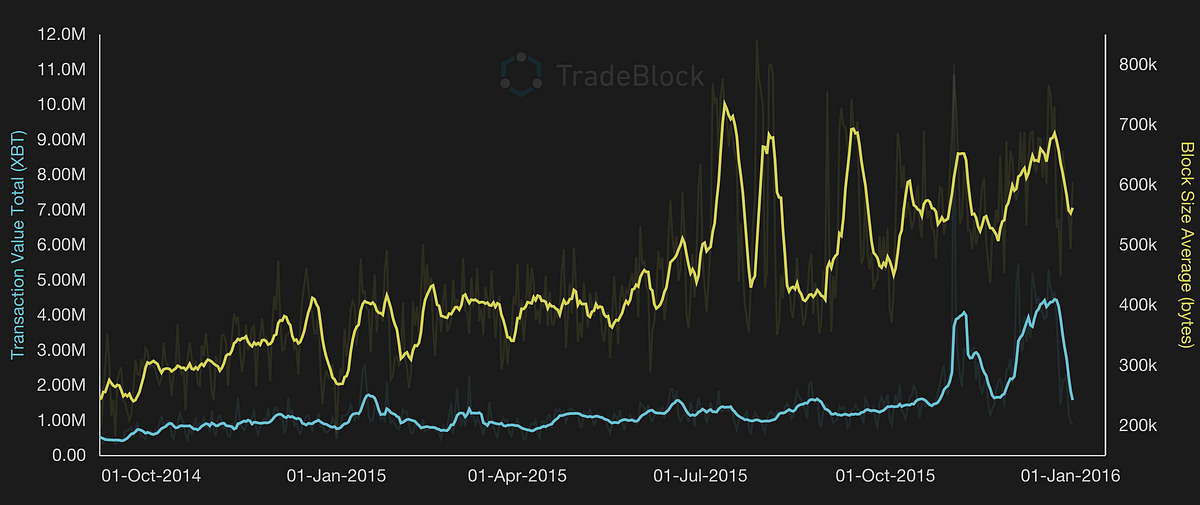
The proposed roadmap currently being discussed in the bitcoin community has some good points in that it does have a plan to accommodate more transactions, but it fails to speak plainly to bitcoin users and acknowledge key downsides.
Core block size does not change; there has been zero compromise on that issue.
In an optimal, transparent, open source environment, a BIP would be produced … this has not happened
One of the explicit goals of the Scaling Bitcoin workshops was to funnel the chaotic core block size debate into an orderly decision making process. That did not occur. In hindsight, Scaling Bitcoin stalled a block size decision while transaction fee price and block space pressure continue to increase.
Failing to speak plainly, as they put it, has become more and more common. As an example, the plan Gavin and Jeff refer to was announced at the “Scaling Bitcoin” conferences but doesn’t involve making anything more efficient, and manages an anemic 60% capacity increase only through an accounting trick (not counting some of the bytes in each transaction). It requires making huge changes to nearly every piece of Bitcoin-related software. Instead of doing a simple thing and raising the limit, it chooses to do an incredibly complicated thing that might buy months at most, assuming a huge coordinated effort.

Replace by fee

One problem with using fees to control congestion is that the fee to get to the front of the queue might change after you made a payment. Bitcoin Core has a brilliant solution to this problem — allow people to mark their payments as changeable after they’ve been sent, up until they appear in the block chain. The stated intention is to let people adjust the fee paid, but in fact their change also allows people to change the payment to point back to themselves, thus reversing it.
At a stroke, this makes using Bitcoin useless for actually buying things, as you’d have to wait for a buyer’s transaction to appear in the block chain … which from now on can take hours rather than minutes, due to the congestion.
Core’s reasoning for why this is OK goes like this: it’s no big loss because if you hadn’t been waiting for a block before, there was a theoretical risk of payment fraud, which means you weren’t using Bitcoin properly. Thus, making that risk a 100% certainty doesn’t really change anything.
In other words, they don’t recognise that risk management exists and so perceive this change as zero cost.
This protocol change will be released with the next version of Core (0.12), so will activate when the miners upgrade. It was massively condemned by the entire Bitcoin community but the remaining Bitcoin Core developers don’t care what other people think, so the change will happen.
If that didn’t convince you Bitcoin has serious problems, nothing will. How many people would think bitcoins are worth hundreds of dollars each when you soon won’t be able to use them in actual shops?
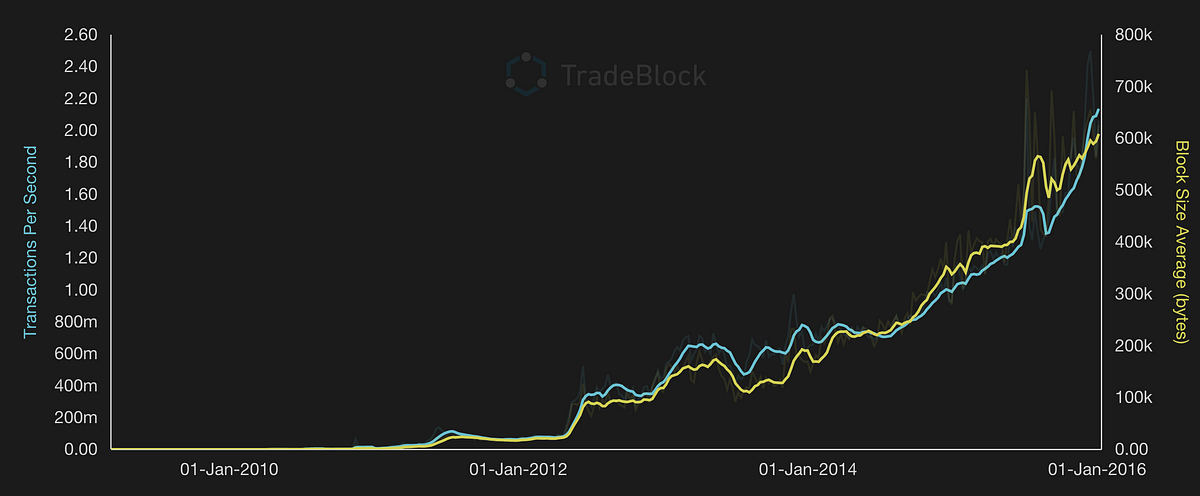
Conclusions

Bitcoin has entered exceptionally dangerous waters. Previous crises, like the bankruptcy of Mt Gox, were all to do with the services and companies that sprung up around the ecosystem. But this one is different: it is a crisis of the core system, the block chain itself.
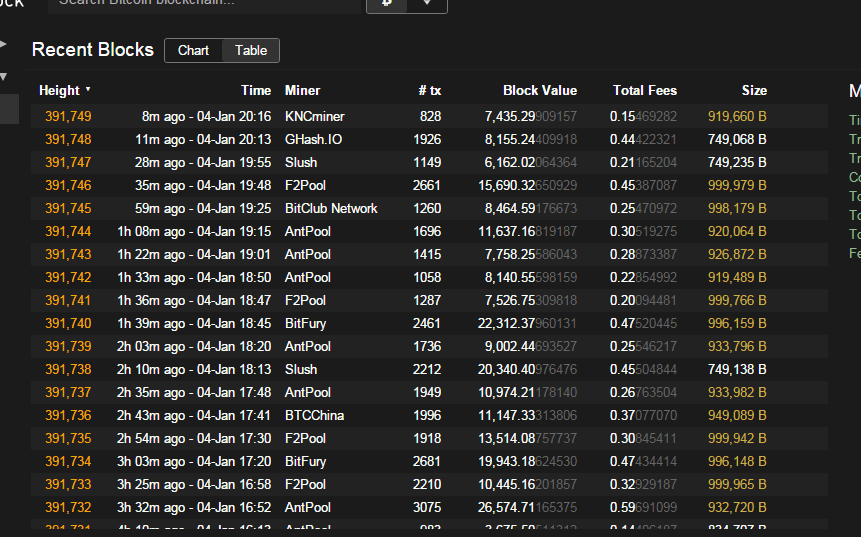
More fundamentally, it is a crisis that reflects deep philosophical differences in how people view the world: either as one that should be ruled by a “consensus of experts”, or through ordinary people picking whatever policies make sense to them.
Even if a new team was built to replace Bitcoin Core, the problem of mining power being concentrated behind the Great Firewall would remain. Bitcoin has no future whilst it’s controlled by fewer than 10 people. And there’s no solution in sight for this problem: nobody even has any suggestions. For a community that has always worried about the block chain being taken over by an oppressive government, it is a rich irony.
Still, all is not yet lost. Despite everything that has happened, in the past few weeks more members of the community have started picking things up from where I am putting them down. Where making an alternative to Core was once seen as renegade, there are now two more forks vying for attention (Bitcoin Classic and Bitcoin Unlimited). So far they’ve hit the same problems as XT but it’s possible a fresh set of faces could find a way to make progress.
There are many talented and energetic people working in the Bitcoin space, and in the past five years I’ve had the pleasure of getting to know many of them. Their entrepreneurial spirit and alternative perspectives on money, economics and politics were fascinating to experience, and despite how it’s all gone down I don’t regret my time with the project. I woke up this morning to find people wishing me well in the uncensored forum and asking me to stay, but I’m afraid I’ve moved on to other things. To those people I say: good luck, stay strong, and I wish you the best.

Mike Hearn