Sunday, January 17, 2016

The failure of the Bitcoin experiment - by the bitcon developer

I’ve spent more than 5 years being a Bitcoin developer. The software I’ve written has been used by millions of users, hundreds of developers, and the talks I’ve given have led directly to the creation of several startups. I’ve talked about Bitcoin on Sky TV and BBC News. I have been repeatedly cited by the Economist as a Bitcoin expert and prominent developer. I have explained Bitcoin to the SEC, to bankers and to ordinary people I met at cafes.
From the start, I’ve always said the same thing: Bitcoin is an experiment and like all experiments, it can fail. So don’t invest what you can’t afford to lose. I’ve said this in interviews, on stage at conferences, and over email. So have other well known developers like Gavin Andresen and Jeff Garzik.
But despite knowing that Bitcoin could fail all along, the now inescapable conclusion that it has failed still saddens me greatly. The fundamentals are broken and whatever happens to the price in the short term, the long term trend should probably be downwards. I will no longer be taking part in Bitcoin development and have sold all my coins.
Why has Bitcoin failed? It has failed because the community has failed. What was meant to be a new, decentralised form of money that lacked “systemically important institutions” and “too big to fail” has become something even worse: a system completely controlled by just a handful of people. Worse still, the network is on the brink of technical collapse. The mechanisms that should have prevented this outcome have broken down, and as a result there’s no longer much reason to think Bitcoin can actually be better than the existing financial system.
Think about it. If you had never heard about Bitcoin before, would you care about a payments network that:
  • Couldn’t move your existing money
  • Had wildly unpredictable fees that were high and rising fast
  • Allowed buyers to take back payments they’d made after walking out of shops, by simply pressing a button (if you aren’t aware of this “feature” that’s because Bitcoin was only just changed to allow it)
  • Is suffering large backlogs and flaky payments
  • … which is controlled by China
  • … and in which the companies and people building it were in open civil war?
I’m going to hazard a guess that the answer is no.

Deadlock on the blocks

In case you haven’t been keeping up with Bitcoin, here is how the network looks as of January 2016.
The block chain is full. You may wonder how it is possible for what is essentially a series of files to be “full”. The answer is that an entirely artificial capacity cap of one megabyte per block, put in place as a temporary kludge a long time ago, has not been removed and as a result the network’s capacity is now almost completely exhausted.
Here’s a graph of block sizes.
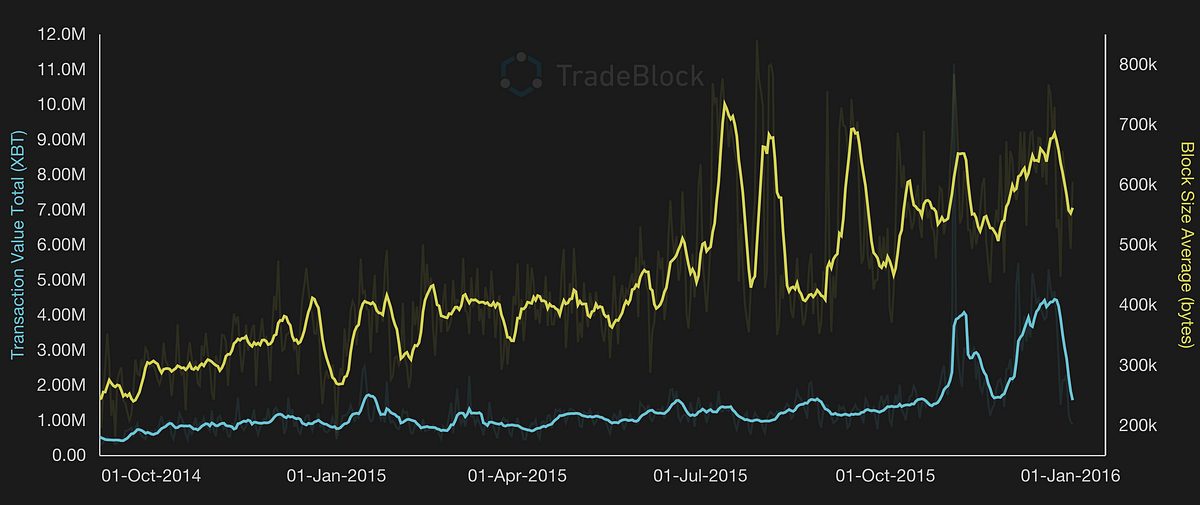
The peak level in July was reached during a denial-of-service attack in which someone flooded the network with transactions in an attempt to break things, calling it a “stress test”. So that level, about 700 kilobytes of transactions (or less than 3 payments per second), is probably about the limit of what Bitcoin can actually achieve in practice
NB: You may have read that the limit is 7 payments per second. That’s an old figure from 2011 and Bitcoin transactions got a lot more complex since then, so the true figure is a lot lower.
The reason the true limit seems to be 700 kilobytes instead of the theoretical 1000 is that sometimes miners produce blocks smaller than allowed and even empty blocks, despite that there are lots of transactions waiting to confirm — this seems to be most frequently caused by interference from the Chinese “Great Firewall” censorship system. More on that in a second.
If you look closely, you can see that traffic has been growing since the end of the 2015 summer months. This is expected. I wrote about Bitcoin’s seasonal growth patterns back in March.
Here’s weekly average block sizes:
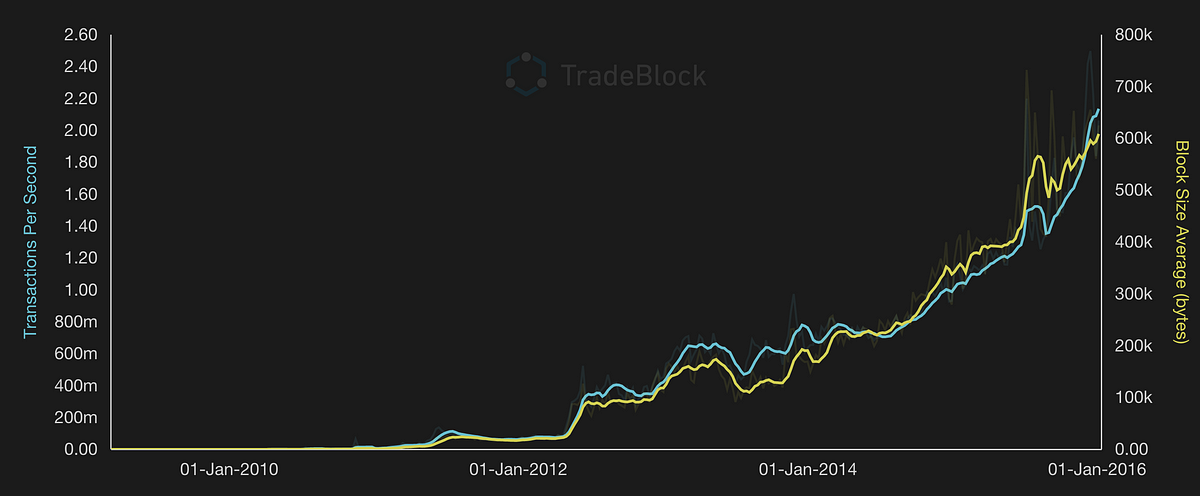
So the average is nearly at the peak of what can be done. Not surprisingly then, there are frequent periods in which Bitcoin can’t keep up with the transaction load being placed upon it and almost all blocks are the maximum size, even when there is a long queue of transactions waiting. You can see this in the size column (the 750kb blocks come from miners that haven’t properly adjusted their software):
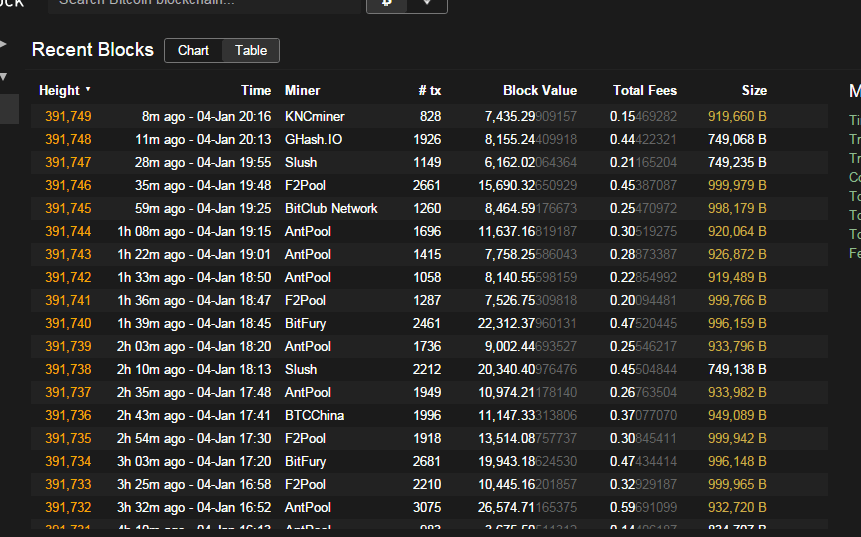
When networks run out of capacity, they get really unreliable. That’s why so many online attacks are based around simply flooding a target computer with traffic. Sure enough, just before Christmas payments started to become unreliable and at peak times backlogs are now becoming common.
Quoting a news post by ProHashing, a Bitcoin-using business:
Some customers contacted Chris earlier today asking why our bitcoin payouts didn’t execute …
The issue is that it’s now officially impossible to depend upon the bitcoin network anymore to know when or if your payment will be transacted, because the congestion is so bad that even minor spikes in volume create dramatic changes in network conditions. To whom is it acceptable that one could wait either 60 minutes or 14 hours, chosen at random?
It’s ludicrous that people are actually writing posts on reddit claiming that there is no crisis. People were criticizing my post yesterday on the grounds that I somehow overstated the seriousness of the situation. Do these people actually use the bitcoin network to send money everyday?
ProHashing encountered another near-miss between Christmas and New Year, this time because a payment from an exchange to their wallet was delayed.
Bitcoin is supposed to respond to this situation with automatic fee rises to try and get rid of some users, and although the mechanisms behind it are barely functional that’s still sort of happening: it is rapidly becoming more and more expensive to use the Bitcoin network. Once upon a time, Bitcoin had the killer advantage of low and even zero fees, but it’s now common to be asked to pay more to miners than a credit card would charge.
Why has the capacity limit not been raised? Because the block chain is controlled by Chinese miners, just two of whom control more than 50% of the hash power. At a recent conference over 95% of hashing power was controlled by a handful of guys sitting on a single stage. The miners are not allowing the block chain to grow.
Why are they not allowing it to grow? Several reasons. One is that the developers of the “Bitcoin Core” software that they run have refused to implement the necessary changes. Another is that the miners refuse to switch to any competing product, as they perceive doing so as “disloyalty” —and they’re terrified of doing anything that might make the news as a “split” and cause investor panic. They have chosen instead to ignore the problem and hope it goes away.
And the final reason is that the Chinese internet is so broken by their government’s firewall that moving data across the border barely works at all, with speeds routinely worse than what mobile phones provide. Imagine an entire country connected to the rest of the world by cheap hotel wifi, and you’ve got the picture. Right now, the Chinese miners are able to — just about — maintain their connection to the global internet and claim the 25 BTC reward ($11,000) that each block they create gives them. But if the Bitcoin network got more popular, they fear taking part would get too difficult and they’d lose their income stream. This gives them a perverse financial incentive to actually try and stop Bitcoin becoming popular.
Many Bitcoin users and observers have been assuming up until very recently that somehow these problems would all sort themselves out, and of course the block chain size limit would be raised. After all, why would the Bitcoin community … the community that has championed the block chain as the future of finance … deliberately kill itself by strangling the chain in its crib? But that’s exactly what is happening.
The resulting civil war has seen Coinbase — the largest and best known Bitcoin startup in the USA — be erased from the official Bitcoin website for picking the “wrong” side and banned from the community forums. When parts of the community are viciously turning on the people that have introduced millions of users to the currency, you know things have got really crazy.

Nobody knows what’s going on

If you haven’t heard much about this, you aren’t alone. One of the most disturbing things that took place over the course of 2015 is that the flow of information to investors and users has dried up.
In the span of only about eight months, Bitcoin has gone from being a transparent and open community to one that is dominated by rampant censorship and attacks on bitcoiners by other bitcoiners. This transformation is by far the most appalling thing I have ever seen, and the result is that I no longer feel comfortable being associated with the Bitcoin community.
Bitcoin is not intended to be an investment and has always been advertised pretty accurately: as an experimental currency which you shouldn’t buy more of than you can afford to lose. It is complex, but that never worried me because all the information an investor might want was out there, and there’s an entire cottage industry of books, conferences, videos and websites to help people make sense of it all.
That has now changed.
Most people who own Bitcoin learn about it through the mainstream media. Whenever a story goes mainstream the Bitcoin price goes crazy, then the media report on the price rises and a bubble happens.
Stories about Bitcoin reach newspapers and magazines through a simple process: the news starts in a community forum, then it’s picked up by a more specialised community/tech news website, then journalists at general media outlets see the story on those sites and write their own versions. I’ve seen this happen over and over again, and frequently taken part in it by discussing stories with journalists.
In August 2015 it became clear that due to severe mismanagement, the “Bitcoin Core” project that maintains the program that runs the peer-to-peer network wasn’t going to release a version that raised the block size limit. The reasons for this are complicated and discussed below. But obviously, the community needed the ability to keep adding new users. So some long-term developers (including me) got together and developed the necessary code to raise the limit. That code was called BIP 101 and we released it in a modified version of the software that we branded Bitcoin XT. By running XT, miners could cast a vote for changing the limit. Once 75% of blocks were voting for the change the rules would be adjusted and bigger blocks would be allowed.
The release of Bitcoin XT somehow pushed powerful emotional buttons in a small number of people. One of them was a guy who is the admin of the bitcoin.org website and top discussion forums. He had frequently allowed discussion of outright criminal activity on the forums he controlled, on the grounds of freedom of speech. But when XT launched, he made a surprising decision. XT, he claimed, did not represent the “developer consensus” and was therefore not really Bitcoin. Voting was an abomination, he said, because:
“One of the great things about Bitcoin is its lack of democracy”
So he decided to do whatever it took to kill XT completely, starting with censorship of Bitcoin’s primary communication channels: any post that mentioned the words “Bitcoin XT” was erased from the discussion forums he controlled, XT could not be mentioned or linked to from anywhere on the official bitcoin.org website and, of course, anyone attempting to point users to other uncensored forums was also banned. Massive numbers of users were expelled from the forums and prevented from expressing their views.
As you can imagine, this enraged people. Read the comments on the announcement to get a feel for it.
Eventually, some users found their way to a new uncensored forum. Reading it is a sad thing. Every day for months I have seen raging, angry posts railing against the censors, vowing that they will be defeated.
But the inability to get news about XT or the censorship itself through to users has some problematic effects.
For the first time, investors have no obvious way to get a clear picture of what’s going on. Dissenting views are being systematically suppressed. Technical criticisms of what Bitcoin Core is doing are being banned, with misleading nonsense being peddled in its place. And it’s clear that many people who casually bought into Bitcoin during one of its hype cycles have no idea that the system is about to hit an artificial limit.
This worries me a great deal. Over the years governments have passed a large number of laws around securities and investments. Bitcoin is not a security and I do not believe it falls under those laws, but their spirit is simple enough: make sure investors are informed. When misinformed investors lose money, government attention frequently follows.

Why is Bitcoin Core keeping the limit?

People problems.
When Satoshi left, he handed over the reins of the program we now call Bitcoin Core to Gavin Andresen, an early contributor. Gavin is a solid and experienced leader who can see the big picture. His reliable technical judgement is one of the reasons I had the confidence to quit Google (where I had spent nearly 8 years) and work on Bitcoin full time. Only one tiny problem: Satoshi never actually asked Gavin if he wanted the job, and in fact he didn’t. So the first thing Gavin did was grant four other developers access to the code as well. These developers were chosen quickly in order to ensure the project could easily continue if anything happened to him. They were, essentially, whoever was around and making themselves useful at the time.
One of them, Gregory Maxwell, had an unusual set of views: he once claimed he had mathematically proven Bitcoin to be impossible. More problematically, he did not believe in Satoshi’s original vision.
When the project was first announced, Satoshi was asked how a block chain could scale to a large number of payments. Surely the amount of data to download would become overwhelming if the idea took off? This was a popular criticism of Bitcoin in the early days and Satoshi fully expected to be asked about it. He said:
The bandwidth might not be as prohibitive as you think … if the network were to get [as big as VISA], it would take several years, and by then, sending [the equivalent of] 2 HD movies over the Internet would probably not seem like a big deal.
It’s a simple argument: look at what existing payment networks handle, look at what it’d take for Bitcoin to do the same, and then point out that growth doesn’t happen overnight. The networks and computers of the future will be better than today. And indeed back-of-the-envelope calculations suggested that, as he said to me, “it never really hits a scale ceiling” even when looking at more factors than just bandwidth.
Maxwell did not agree with this line of thinking. From an interview in December 2014:
Problems with decentralization as bitcoin grows are not going to diminish either, according to Maxwell: “There’s an inherent tradeoff between scale and decentralization when you talk about transactions on the network.”
The problem, he said, is that as bitcoin transaction volume increases, larger companies will likely be the only ones running bitcoin nodes because of the inherent cost.
The idea that Bitcoin is inherently doomed because more users means less decentralisation is a pernicious one. It ignores the fact that despite all the hype, real usage is low, growing slowly and technology gets better over time. It is a belief Gavin and I have spent much time debunking. And it leads to an obvious but crazy conclusion: if decentralisation is what makes Bitcoin good, and growth threatens decentralisation, then Bitcoin should not be allowed to grow.
Instead, Maxwell concluded, Bitcoin should become a sort of settlement layer for some vaguely defined, as yet un-created non-blockchain based system.

The death spiral begins

In a company, someone who did not share the goals of the organisation would be dealt with in a simple way: by firing him.
But Bitcoin Core is an open source project, not a company. Once the 5 developers with commit access to the code had been chosen and Gavin had decided he did not want to be the leader, there was no procedure in place to ever remove one. And there was no interview or screening process to ensure they actually agreed with the project’s goals.
As Bitcoin became more popular and traffic started approaching the 1mb limit, the topic of raising the block size limit was occasionally brought up between the developers. But it quickly became an emotionally charged subject. Accusations were thrown around that raising the limit was too risky, that it was against decentralisation, and so on. Like many small groups, people prefer to avoid conflict. The can was kicked down the road.
Complicating things further, Maxwell founded a company that then hired several other developers. Not surprisingly, their views then started to change to align with that of their new boss.
Co-ordinating software upgrades takes time, and so in May 2015 Gavin decided the subject must be tackled once and for all, whilst there was still about 8 months remaining. He began writing articles that worked through the arguments against raising the limit, one at a time.
But it quickly became apparent that the Bitcoin Core developers were hopelessly at loggerheads. Maxwell and the developers he had hired refused to contemplate any increase in the limit whatsoever. They were barely even willing to talk about the issue. They insisted that nothing be done without “consensus”. And the developer who was responsible for making the releases was so afraid of conflict that he decided any controversial topic in which one side might “win” simply could not be touched at all, and refused to get involved.
Thus despite the fact that exchanges, users, wallet developers, and miners were all expecting a rise, and indeed, had been building entire businesses around the assumption that it would happen, 3 of the 5 developers refused to touch the limit.
Deadlock.
Meanwhile, the clock was ticking.

Massive DDoS attacks on XT users

Despite the news blockade, within a few days of launching Bitcoin XT around 15% of all network nodes were running it, and at least one mining pool had started offering BIP101 voting to miners.
That’s when the denial of service attacks started. The attacks were so large that they disconnected entire regions from the internet:
“I was DDos’d. It was a massive DDoS that took down my entire (rural) ISP. Everyone in five towns lost their internet service for several hours last summer because of these criminals. It definitely discouraged me from hosting nodes.”
In other cases, entire datacenters were disconnected from the internet until the single XT node inside them was stopped. About a third of the nodes were attacked and removed from the internet in this way.
Worse, the mining pool that had been offering BIP101 was also attacked and forced to stop. The message was clear: anyone who supported bigger blocks, or even allowed other people to vote for them, would be assaulted.
The attackers are still out there. When Coinbase, months after the launch, announced they had finally lost patience with Core and would run XT, they too were forced offline for a while.

Bogus conferences

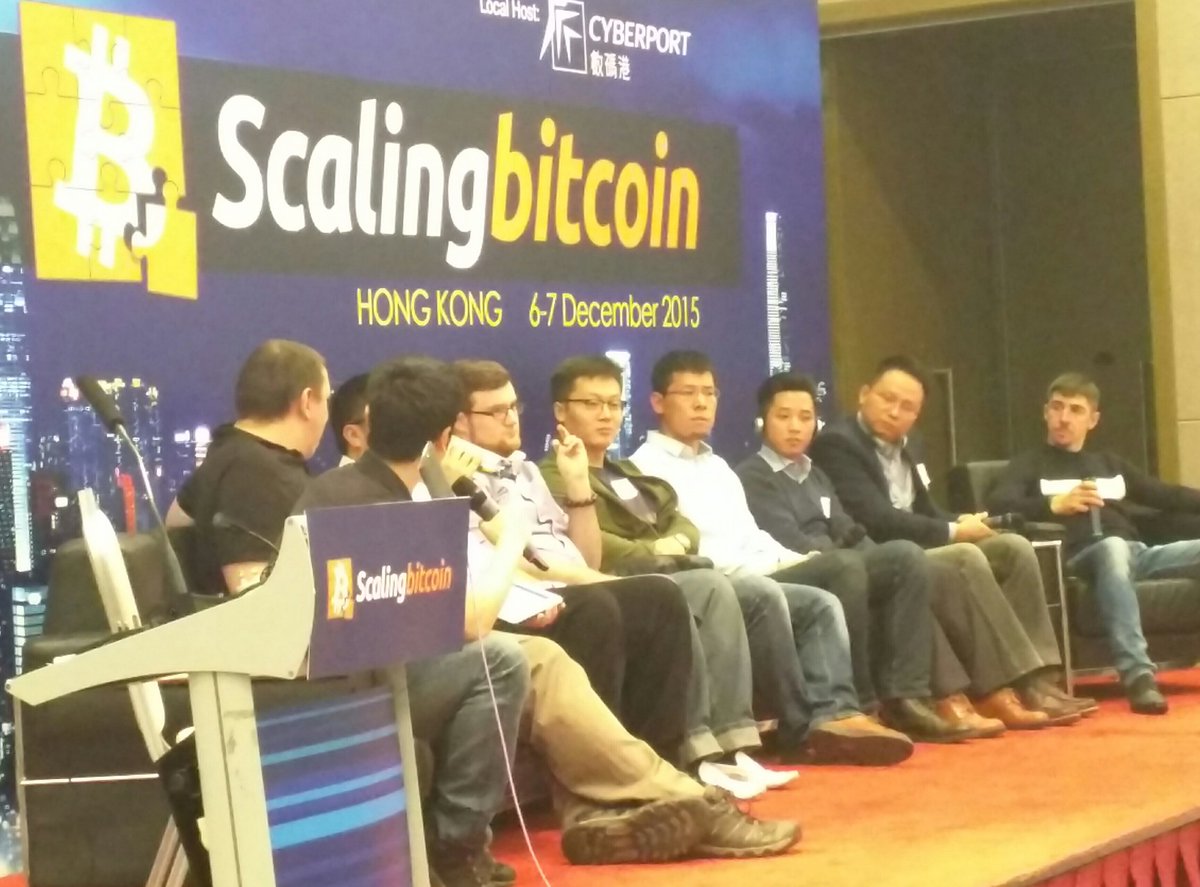
Despite the DoS attacks and censorship, XT was gaining momentum. That posed a threat to Core, so a few of its developers decided to organise a series of conferences named “Scaling Bitcoin”: one in August and one in December. The goal, it was claimed, was to reach “consensus” on what should be done. Everyone likes a consensus of experts, don’t they?
It was immediately clear to me that people who refused to even talk about raising the limit would not have a change of heart because they attended a conference, and moreover, with the start of the winter growth season there remained only a few months to get the network upgraded. Wasting those precious months waiting for conferences would put the stability of the entire network at risk. The fact that the first conference actually banned discussion of concrete proposals didn’t help.
So I didn’t go.
Unfortunately, this tactic was devastatingly effective. The community fell for it completely. When talking to miners and startups, “we are waiting for Core to raise the limit in December” was one of the most commonly cited reasons for refusing to run XT. They were terrified of any media stories about a community split that might hurt the Bitcoin price and thus, their earnings.
Now the last conference has come and gone with no plan to raise the limit, some companies (like Coinbase and BTCC) have woken up to the fact that they got played. But too late. Whilst the community was waiting, organic growth added another 250,000 transactions per day.

A non-roadmap

Jeff Garzik and Gavin Andresen, the two of five Bitcoin Core committers who support a block size increase (and the two who have been around the longest), both have a stellar reputation within the community. They recently wrote a joint article titled “Bitcoin is Being Hot-Wired for Settlement”.
Jeff and Gavin are generally softer in their approach than I am. I’m more of a tell-it-like-I-see-it kinda guy, or as Gavin has delicately put it, “honest to a fault”. So the strong language in their joint letter is unusual. They don’t pull any punches:
The proposed roadmap currently being discussed in the bitcoin community has some good points in that it does have a plan to accommodate more transactions, but it fails to speak plainly to bitcoin users and acknowledge key downsides.
Core block size does not change; there has been zero compromise on that issue.
In an optimal, transparent, open source environment, a BIP would be produced … this has not happened
One of the explicit goals of the Scaling Bitcoin workshops was to funnel the chaotic core block size debate into an orderly decision making process. That did not occur. In hindsight, Scaling Bitcoin stalled a block size decision while transaction fee price and block space pressure continue to increase.
Failing to speak plainly, as they put it, has become more and more common. As an example, the plan Gavin and Jeff refer to was announced at the “Scaling Bitcoin” conferences but doesn’t involve making anything more efficient, and manages an anemic 60% capacity increase only through an accounting trick (not counting some of the bytes in each transaction). It requires making huge changes to nearly every piece of Bitcoin-related software. Instead of doing a simple thing and raising the limit, it chooses to do an incredibly complicated thing that might buy months at most, assuming a huge coordinated effort.

Replace by fee

One problem with using fees to control congestion is that the fee to get to the front of the queue might change after you made a payment. Bitcoin Core has a brilliant solution to this problem — allow people to mark their payments as changeable after they’ve been sent, up until they appear in the block chain. The stated intention is to let people adjust the fee paid, but in fact their change also allows people to change the payment to point back to themselves, thus reversing it.
At a stroke, this makes using Bitcoin useless for actually buying things, as you’d have to wait for a buyer’s transaction to appear in the block chain … which from now on can take hours rather than minutes, due to the congestion.
Core’s reasoning for why this is OK goes like this: it’s no big loss because if you hadn’t been waiting for a block before, there was a theoretical risk of payment fraud, which means you weren’t using Bitcoin properly. Thus, making that risk a 100% certainty doesn’t really change anything.
In other words, they don’t recognise that risk management exists and so perceive this change as zero cost.
This protocol change will be released with the next version of Core (0.12), so will activate when the miners upgrade. It was massively condemned by the entire Bitcoin community but the remaining Bitcoin Core developers don’t care what other people think, so the change will happen.
If that didn’t convince you Bitcoin has serious problems, nothing will. How many people would think bitcoins are worth hundreds of dollars each when you soon won’t be able to use them in actual shops?

Conclusions

Bitcoin has entered exceptionally dangerous waters. Previous crises, like the bankruptcy of Mt Gox, were all to do with the services and companies that sprung up around the ecosystem. But this one is different: it is a crisis of the core system, the block chain itself.
More fundamentally, it is a crisis that reflects deep philosophical differences in how people view the world: either as one that should be ruled by a “consensus of experts”, or through ordinary people picking whatever policies make sense to them.
Even if a new team was built to replace Bitcoin Core, the problem of mining power being concentrated behind the Great Firewall would remain. Bitcoin has no future whilst it’s controlled by fewer than 10 people. And there’s no solution in sight for this problem: nobody even has any suggestions. For a community that has always worried about the block chain being taken over by an oppressive government, it is a rich irony.
Still, all is not yet lost. Despite everything that has happened, in the past few weeks more members of the community have started picking things up from where I am putting them down. Where making an alternative to Core was once seen as renegade, there are now two more forks vying for attention (Bitcoin Classic and Bitcoin Unlimited). So far they’ve hit the same problems as XT but it’s possible a fresh set of faces could find a way to make progress.
There are many talented and energetic people working in the Bitcoin space, and in the past five years I’ve had the pleasure of getting to know many of them. Their entrepreneurial spirit and alternative perspectives on money, economics and politics were fascinating to experience, and despite how it’s all gone down I don’t regret my time with the project. I woke up this morning to find people wishing me well in the uncensored forum and asking me to stay, but I’m afraid I’ve moved on to other things. To those people I say: good luck, stay strong, and I wish you the best.

Mike Hearn

Saturday, January 16, 2016

Obama’s Executive Order that would mandate Feds to engage in sickening mind control practices

It sounds incredible, even given the devolution of the United States presidency into a pseudo-dictatorship under Hussein Obama. A new executive order issued by the occupier of the White House on Tuesday directs federal agencies to conduct behavioral experiments on US citizens as a means of advancing “government initiatives.” WND put it simply, “Federal agencies have been directed to hire psychologists to experiment and find ways to better manipulate the American people to the federal government’s will.”
The Executive Order reads, “A growing body of evidence demonstrates that behavioral science insights — research findings from fields such as behavioral economics and psychology about how people make decisions and act on them — can be used to design government policies to better serve the American people.” Guess it’s all in how one defines “better service.”
The new program is based, according to a report in the Daily Caller, upon a 2013 proposal which was titled, “Strengthening Federal Capacity for Behavioral Insights.” The federal capacity for control is enhanced through a better understanding of how people respond to various stimuli. That’s not necessarily a good thing; in fact, it’s probably a very bad thing or could at a minimum be converted or distorted into many very bad things.
Like it or not, sickening mind control methods have been going on in our government for quite some time. However, many people have written it off as ‘conspiracy’ and simply ‘not true’. But now it is all laid out for you clearly in our media, that these type of sickening practices do indeed go on within our government and are imposed upon innocent people (victims).  
Who are the victims?  You, me, and even worse, our children…

Friday, January 15, 2016

Obviously we did not go to the moon and Russia knew it

What To Expect In 2016

Only A Paper Moon (The Apollo Moon Landings Hoax Exposed)

Thousands of ‘refugees’ have entered the West but where are the woman, children and elderly?

Jihadis in Great Britain 2016
Military Jihadi's imported to create OPERATION MAYHEM

Dow dumps 600 points, on top of 2200 points in a week in losses. Trillions erased.

And wanker just said the economy was fine and dandy...what a lying tool

Feds Burning Cows ALIVE, Torching Homes, Imprisoning Ranchers!

The WIndow Dressing likes to spin BIG LIES to average people

And anyone saying something like that to millions is the worst kind of devil

Thursday, January 14, 2016

Radioactive Material Reportedly Released from Massive Gas Blowout In Cal...

5 Mysterious Clues That Prove Giants Did Exist

Near DEAD LAST IN ANY POLL, Hitlary will still end up our president (cuz the satanic networks says so)

A loser by any other name is President Bitch

Negative Interest rates for regular people PLUS 5 to 12% inflation (real inflation, not that fake garbage the fed liars put out) Means NEGATIVE INTEREST RATES

This means every dollar you have is daily shrinking by .12% per day. Every day. In buying power.

stealing your money and they don't go to jail neither

The real cause of the Great Depression wasn't the crash of 1929, but was created by bankers through CONTRACTING CREDIT AND . That's right, the FED did it to us and the world, for Ten Long Years.

And they are already doing it again. KABOOM.


Bank Lending in the Great Depression
First, let’s examine what happened to bank lending in the Great Depression. Figure 1 presents commercial bank loans in two formats, outstanding values (blue line) and annual percentage rate of change in loans (red bars). This figure helps us to evaluate the period from 1915 to 1946, including the Great Depression. The period includes seven recessions as defined by the National Bureau of Economic Research or NBER and shown as gray shaded bars.2
The 1929 financial crisis and the Great Depression took a huge toll on commercial bank lending, which at the time represented the bulk of total lending in the economy.3 Figure 1 provides dramatic evidence of how bank lending plunged following the stock market collapse in 1929 and the onset of the Great Depression.4 Total loan values, which peaked at nearly $36 billion in 1929, fell by more than $21 billion or 58.5 percent over the next 5½ years (blue line in Figure 1). At the same time, economic output contracted and led to a period of deflation, when the overall price level fell sharply for several years. The annual percentage change (red bars in Figure 1) indicate that loans plummeted by more than 20 percent in both 1932 and 1933 and contracted for six consecutive years from 1930 to 1935.
Figure 1. Total Loans at All Commercial Banks Collapsed in the Great Depression

Lending in the Great Recession Compared with the Great Depression
Generating a comparison between lending in the Great Depression and the Great Recession presents some challenges. Loan data are not available on the same frequency for the two periods and differences in the scale are huge. To adjust for these differences, I constructed an index with a value of 100 representing the pre-crisis peak in loans for both periods.5 This index, shown as Figure 2, tracks percent changes in total bank loans for both periods on the same scale.6
Figure 2 shows that the decline in loans during the Great Recession pales in comparison to the Great Depression. In the most recent episode, ten quarters after the 2008 peak in bank lending, total loans had fallen by over 16 percent, which is a dramatic decline by post-World War II standards but small compared to the drop of 39 percent for the first ten quarters of the Great Depression.
Figure 2 also shows that bank lending increased slightly in the recovery following the Great Recession, starting ten quarters after the financial crisis peak. This modest growth resulted from improved bank industry conditions, looser lending standards, and increased loan demand.7
In contrast, following the Great Depression, total loans continued to decline at a rapid pace much longer. When loans outstanding finally stabilized, it was at a level about 58 percent below the 1929 peak. Thus, the decline in lending during the Great Depression was much more severe and lasted much longer than during the Great Recession.
Figure 2. The Decline in Bank Loans in the Great Depression Lasted Longer and Was Much More Severe than in the Great Recession.

How large was the decline in lending as a share of the economy?
We can take this analysis a step further using the available historical data and scaling bank loans as a percent of gross domestic product (GDP), the total output of the economy over a period of time. This allows us to account for the deeper and longer decline in GDP during the Great Depression.
This measure, shown in Figure 3, plots bank loans as a share of GDP for both periods. Over the course of the Great Depression this measure fell about 57 percent from the business cycle peak to the trough seven years later.8 In contrast, during the Great Recession, bank loans as a percentage of GDP fell less than 20 percent from the peak to the trough four years later. Again, by this measure as well, the downturn in lending relative to the size of the overall economy was more severe during the Great Depression.
Figure 3. The Decline in Bank Loans as a Share of Gross Domestic Product also Was More Severe in the Great Depression than in the Great Recession.

URGENT: 3 NEW SIGNS TOTAL ECONOMIC COLLAPSE IS IN PROGRESS

Tuesday, January 12, 2016

Last-Hour Buying-Panic by the PLUNGE PROTECTION TEAM Saves Nasdaq From Longest Losing Streak In 31 Years (THE CRASH OF 2016 IS ON)

8 down days as of yesterday was longest losing streak since Jan 2008 but a red close today would have made it 9 down days in a row - The longest losing streak for Nasdaq Composite since May 1984
Deja Vu All Over Again...


As once again, USDJPY took over after NYMEX closed...


A desperate attempt to squeeze shorts at the open (Most Shorted spiked over 2% at the open) gave way to selling pressure... but then as soon as NYMEX closed - the squeeze resumed...


So panic buying stocks and panic-selling VIX saved the day...once again all sponsored by the NYMEX Close...


Leaving all the majors green by the close


Futures show the swings best...


1225 Dow points in 24 hours!!!


But it appears insiders are selling (since QE3 ended)...

h/t @NorthmanTrader

High yield credit markets remain deeply recessionary at these levels...


Treasury yields collapsed today (as China stopped supporting Offshore Yuan)... 30Y yields crashed 13bps from high to low back to 2.875%


It's pretty clear that yesterday's "odd" weakness in Treasuries given equity tumble was due to China selling TSYs sto fund their defense of the Offshore Yuan (and today we catch back down as they offer disappears)...


The USD Index pushed higher again today with CAD dumping under 70c for the first time since 2003...

  • *RUSSIAN RUBLE CLOSES AT RECORD-LOW 77.0650 PER USD

Commodities were very mixed with copper and crude carnaging while gold and silver were flat but started to accelerate higher into the last hour as things started breaking...


WTI broke down below $30 foir the first time since December 2003...


So fingers crossed that China does not open and that API does not have a huge build (as expected).

http://www.zerohedge.com/news/2016-01-12/last-hour-buying-panic-saves-nasdaq-longest-losing-streak-31-years

Happy Birthday DB!

Tink has it dead easy...

A gas storage field from 1953 is slowly killing north LA County

Last fall, a 7-inch injection well pipe ruptured 500 feet below the surface of Los Angeles, after ferrying natural gas for six decades. The resulting methane leak is now being called one of the largest environmental disasters since the BP oil spill, has pushed thousands of people out of their homes, and has quickly become the single biggest contributor to climate change-causing greenhouse gas emissions in California. But it's not the first time this well sprang a leak—and Southern California Gas Company (SoCalGas), which owns and operates the well, knew it.
Over the past three months, engineers have had a terrifically difficult time plugging the leak. Normally in the case of a methane leak, a column of fluid would be pumped down into the well, to stem its tide. But with this particular well, that hasn’t been working. Instead, workers must drill down to the base of the well, 8,000 feet underground, creating a relief well to relieve the incredibly high pressure of the leak. Only then can the leak be repaired safely.
So who’s to blame for a leak that cannot be stopped? Aging natural gas equipment may have contributed. According to documents filed with the California Division of Oil, Gas & Geothermal Resources, this particular well, referred to as Standard Sesnon 25, was originally drilled in 1953, and showed signs of leakage 24 years ago, in 1992. Inspectors reported that they could hear the leak through borehole microphones.
Gene Nelson, a professor of physical science at Cuesta College in San Luis Obispo, California who has seen the document, said that he found it “appalling that SoCalGas did not identify this as a well to shut off,” after receiving this feedback.
There have been other problems documented at this facility before. And in 2014, inspectors at the wells documented corrosion and negative integrity trends.
In 2013, SoCalGas applied for and received money to do upgrades on equipment like safety valves—money that the Environmental Defense Fund (EDF) says should have been used to prevent a leak like this. The regulatory decision filing shows that SoCalGas was granted $898,000 per year (in addition to the regular fund of about $3 million per year for repairs) to replace 5 percent of its safety valves at Aliso Canyon. According to EDF, these extra funds weren’t used as they should have been—to prevent a leak of this magnitude.
In 2014, written testimony to the California Public Utilities Commission by SoCalGas Director of Storage Operations Phillip Baker documented corrosion and negative integrity trends in the aging pipeline.
“Without a new inspection plan, SoCalGas and customers could experience major failures and service interruptions from potential hazards that currently remain undetected,” he wrote. The filing also noted that as of 2014, half of the company’s 229 storage wells were over 57 years old, and 52 wells were more than 70 years old.

“The company should be holding themselves to highest standard of care,” said Tim O’Connor, Director of California oil and gas for EDF, adding that SoCal should have had emergency plans in place to prevent long-term leaks from occurring. “This leak is a symptom of a larger issue—aging oil and gas infrastructure. We just don’t have a system to properly deal with storage leaks yet.”
Other safety issues have been pointed out recently, too. Earlier this month, The LA Times reported that attorneys representing some of the 1,000 residents suing SoCalGas over the leak claim the company failed to replace an important safety valve that was removed in 1979—a valve that could have stopped the current leak in its tracks. The plaintiffs also allege that the company again identified leaks at the site five years ago, but never implemented plans to fix them.
When pressed about the age of the pipes and the safety history of the well, a spokesperson for Sempra Utilities, the company that owns SoCalGas, said that the company performs daily well checks, and that this well had passed its last inspection:
Over time, the technology to monitor and operate underground gas storage field has developed steadily, and our facilities are at the forefront of safety controls and procedures. In addition, all our operations are closely monitored for compliance with the safety standards of the California Public Utilities Commission, the Division of Oil and Gas, the Occupational Safety and Health Administration, and local fire departments.
Now, three months after the pipe first burst, Gov. Jerry Brown has proclaimed a state of emergency in California. The declaration grants the state more powers to oversee the response, gives more authority to health officials, forces the utility to maximize its gas withdrawals, and ramps up safety inspections at the Aliso Canyon Underground Storage Facility in Porter Ranch—a neighborhood of Los Angeles where over 100,000 pounds of methane are now being pumped into California’s air every hour. The proclamation will likely allow more funds to be diverted to assist in cleanup efforts, and creates an independent panel to assess what went wrong with the leak and to assess its impact on human health.
Leak site. Image: Earthworks
Dennis Arriola, president and CEO of the Southern California Gas Company, which owns the Aliso facility, issued a statement saying that the company “has been communicating with the Governor’s Office and other state agencies from the outset….[and] reaffirms our prior commitment to mitigate the environmental impact of the actual amount of natural gas released from the leak.”
Robert Howarth, a professor of ecology and environmental biology at Cornell University and an expert in the impacts of greenhouse gas emissions, called the Porter Ranch leak “spectacularly large,” adding that it is likely adding 5 percent to the total amount of methane leaked by the entire US oil and gas industry right now. (Natural gas consists primarily of methane, which constantly leaks, in much smaller amounts, from oil and gas fields around the nation.) What’s more, says Howarth, the methane is incredibly sticky—meaning, it’s going to stay in the atmosphere.

“Once the methane is in the air, it will be there for 10-plus years until it is chemically converted to carbon dioxide and methane,” said Howarth. “ We cannot do anything about that to speed its loss up. And during those 10-plus years, it is more than 100 times more potent as a greenhouse gas than is carbon dioxide.”
In other words, the methane coming out of this leak is catastrophically worse for the climate than the pollution we pump into the atmosphere from cars and planes and trains every day.
So far, some 2,300 homes have voluntarily evacuated and several schools have been closed, with many residents complaining of headaches and nosebleeds from the foul-smelling chemical additives. These include radon, hydrogen sulfide, and an odorant called mercaptan, which is added to the gas both before and after it leaves the storage field.
The well, which funnels natural gas to 22 million customers in the Los Angeles Basin, is expected to take another three months to plug. O’Connor says that the disaster is a telling sign about the viability of natural gas in a country of aging infrastructure.
“We need to take a hard look at whether we can prevent these types of leaks,” he said, adding that smaller methane leaks at oil and gas facilities happen frequently. “These problems fly below the radar until catastrophes happen—and a catastrophe has just happened.”
 
 http://www.zerohedge.com/news/2016-01-12/company-behind-las-methane-disaster-knew-its-well-was-leaking-24-years-ago
 

Friday, January 8, 2016

World's First Real HD Spy Pen (h.264)

Spy Camera Watch - How they film you without your knowledge

Are these NSA spy towers??? You decide!

Nurses Confession: Obamacare

planned-parenthood-to-endorse-hillary-clinton.html

http://www.foxnews.com/politics/2016/01/07/planned-parenthood-to-endorse-hillary-clinton.html

Imperious leader of a death cult

Cop Attacks Mother of Child Murdered by Cops on Facebook: “Raise Your Kids Not to Play with Fake Guns, Stupid B*tch”

Wow. It’s bad enough we live in a country where police kill an average of at least three people every single day, a figure that has risen since last year.
It’s bad enough we live in a country where, despite the fact that the government collects every piece of data on us it possibly can, somehow the authorities just now got around to deciding to create a database on people who are killed by cops.
It’s sad enough we live in a country where schools have been locked down over Nerf guns, and kids like Tamir Rice have been shot dead in seconds for playing with a toy gun in a park.
But on top of the police state of affairs in modern America, this is just utterly disgusting and despicable behavior coming from another one of those guys with the costume, badge, and gun who is supposed to be protecting and serving the public.
Mobile Patrol Officer Matt Cicero, who works at the school district Tamir Rice attended, took to Facebook to tell off Tamir’s mother because she “just want money” and also educate her on what she can do to be a better mommy with stellar commentary including “raise your kids not to play with fake guns stupid bitch”.
matt-cicero
Because people who become cops never, ever play with toy guns as a child.
It’s bad enough her child is dead and died the way he did.
If you’ll recall, in the Rice case the cop jumped out of the car and shot Tamir dead in less than two seconds before the kid even had a chance to respond to police demands that he drop his toy gun, and that was after the caller who made the initial 911 call informed the dispatcher not once, but twice that Tamir might be a kid and the gun might be just a toy.
The saddest part is that by his own comments Officer Cicero, who has been given a paid vacation for his commentary (but will, of course, get to keep his job policing the school district even though he seems to have no problem with publicly mocking the mothers of murdered children), typifies the police state executioner cop that dominates headlines these days… a trigger happy moron who appears to have no problem at all killing people and even kids first and asking questions later.
(Hat Tip: Free Thought Project)
Delivered by The Daily Sheeple

Wednesday, January 6, 2016

Another 4 inches of rain, Ojai Calif

And more coming

snow capped peaks in Ojai


California: State of Emergency Declared Over Huge Methane Leak In Los An...

At the end of 2008, the West’s puppet governments succumbed to History’s ultimate act of blackmail at the hands of History’s largest and most rapacious crime syndicate: the One Bank . “Give us all your money, or we’ll blow up your entire financial system.” That is the real meaning of “too big to fail”: institutionalized extortion, in perpetuity.

What was the real price tag for this massive extortion operation? Forget the phony numbers published by our corrupt governments and their mouthpieces in the corporate media. The total quantum for these extortion payments was in the tens of TRILLIONS . Obviously the Deadbeat Debtors of the West couldn’t raise more than a tiny fraction of that amount of blackmail money up front. Thus, most of this shakedown of (supposedly) sovereign governments came in the form of future tax breaks and “loss guarantees.”
In the Shakedown of ’08, our governments did not merely clean out every penny they could scrounge from our public treasuries and borrow every penny that they could. In addition, they mortgaged the future of our children and grandchildren by pledging infinite corporate welfare for the One Bank.
Western governments had no money left to spend on their own people after committing tens of trillions in extortion payments to this banking crime syndicate while also having to deal with rapidly rising interest payments (to the same crime syndicate) on all their new debts. So Western governments then pulled out their chainsaws and attacked our social programs.
http://www.zerohedge.com/news/2016-01-05/how-iceland-escaped-one-bank

A California Starbucks cashier got caught red-handed stealing a customer’s credit card information

A California Starbucks cashier got caught red-handed stealing a customer’s credit card information, and faced the grande wrath of her furious victim.
Juana Martinez unloaded a fiery tirade Sunday in Lakewood on the sticky-fingered cashier, who was stunned and admitted to the crime after being confronted by the theft victim.
The 2-minute 30-second clip has since gone viral, a penalty worse than arrest for the 19-year-old coffee shop employee, Martinez told The Daily News.
"I think this is a worse punishment, honestly," Martinez said. "I think it's more than enough that she's all over the Internet. People will know who she is."
In the clip, the teen cashier identified as "Chanel" greets the customer and hands her a drink with a smile, which quickly turned into a frightful grimace once Martinez called her out for swiping her credit card digits.
COPS HUNT WEDDING CRASHER WHO ROBS COUPLE AND GUESTS
“So we got you on camera yesterday at Ralph’s for $212,” the irate woman reveals to the cashier. “They recorded your ass and everything, you took a copy of my f--king card on New Year’s Day, you know what you did!”
The nervous Starbucks employee first tries to play dumb, but then immediately fesses up to her coffee shop con, apologizing profusely.
“I’m sorry that I took money from you and your kids, I’m sorry that you had to come up here, I’m sorry that this is inconvenient for you,” the sheepish teen said.
Martinez told The News the cashier stole money that would have been used for her three children, all 6 years old and younger, as well as her husband, an eight-year veteran of the Army stationed in California.
Martinez was already suspicious when the cashier took too long to return her card on Friday, and brought her card to a back room. The next day, Martinez saw on her bill a suspicious $212 transaction at a grocery store, and immediately suspected the cashier.
“You come to Starbucks to get coffee, not to get robbed,” she yelled at the teen in the viral clip.
The crooked cashier admitted that she copied down the card’s numbers while taking her order.
A Starbucks cashier goes from smiling to fearing for her life after being called out for stealing this customer's credit card information.

A Starbucks cashier goes from smiling to fearing for her life after being called out for stealing this customer's credit card information.

The Starbucks worker pleaded with her furious victim not to press charges, and even offered to pay back the money she stole.
The 19-year-old told Martinez said that she was a “good child” who went to school and played soccer.
But the time for playing innocent was over.
Martinez told The News she filed a police report immediately after, and turned over the video as evidence. She had no plans for the clip to go viral, but her little brother uploaded the clip to warn of the cashier's Starbucks scam.
“I almost feel bad for the girl but she robbed the wrong person,” her brother, Brian Espinoza, said.
Martinez says she decided to drop the charges. She said the teen lost her job and most likely any chance of getting a new one after her terrified face was shown around the world wide web.
Lakewood deputies said they investigated the crime report, but did not make any arrests.
"Everyone deserves a second chance, hopefully she learns from this," Martinez said. "That's the moral of the story. You can't go stealing people's credit card information without consequences."
She got a call from a Starbucks exec, who said the cashier was fired.
“We were extremely troubled to learn of this incident and are working directly with the customer to address the situation,” Riley said.
Martinez, who said she used to go to Starbucks daily, said she has not returned since.

Tuesday, January 5, 2016

LAKE TAHOE: DROUGHT IS ENDING, GIANT SNOWPACK HAS RETURNED.

So why are the wankers insisting that all this RECORD SNOWPACK - and the rains are JUST BEGINNING - won't do a thing for the drought in the west? Why do they keep some reservoirs filled to overflowing and keep others nearly empty for the media? I've personally seen full reservoirs drained to nothing in a matter of weeks.


Why is the hottest futures investment commodities angle to be touted for the upcoming IPO trots all related to CONTROL OF WATER?


why is no one talking about these facts?

http://investmentwatchblog.com/narcotics-cop-who-ruined-countless-lives-for-weed-possession-busted-with-2-million-in-marijuana/

” A California police officer was recently busted after driving 247 pounds of marijuana all the way across the country. Yuba County Deputy Christopher M. Heath was caught in York, Pennsylvania with a shipment of marijuana that was worth over $2 million.

The York County Police Department has been cautiously silent about the investigation, and they have refused to comment on the details of the arrest, and how they became aware of the shipment.

Investigators also had no idea that Heath was a cop until after the bust.
Heath, along with two other men, Tyler N. Long, and Ryan J. Falsone traveled across the country in two pickup trucks where the marijuana was stashed in vacuum sealed bags.
“We spend a majority of our time focusing on heroin and cocaine (dealers),” Sunday said. However, he defended the arrest by saying that the men were caught with “a startling amount of marijuana.”

This case is especially interesting because Heath was an officer on a narcotics task force, meaning that he was responsible for putting nonviolent people in prison for using and selling drugs. Meanwhile, he himself was selling drugs and taking part in the same actions that he was locking people up for.

This hypocrite is currently on paid vacation from the department in Yuba despite admitting to transporting the marijuana from California to Pennsylvania. Heath is free on a 1$ million bond.
http://www.blacklistednews.com/Narcotics_Cop_Who_Ruined_Countless_Lives_for_Weed_Possession,_Busted_with_$2_Million_in_Marijuana/48144/0/38/38/Y/M.html

BLM Destroying Ranches by Fire

Ojai Calif, 3 inches of rain and counting

largest rainfall and snowpack records in years in Sierras

Monday, January 4, 2016

Feminists Ban Clapping Because it Triggers 'Anxiety'!

Paypal Wants Brain Chips to Replace Passwords

Aha.. It turns Out That The Hammond Ranch Is Sitting On Natural Gas And Uranium that China Wants..Like The Bundys Ranch Was.....


Why the Hammonds?

“The story is like an onion, you just keep peeling back the layers,” Maupin said.

In an effort to stave off what they feared was a pending Clinton/Babbitt monument designation in 2000, a group of ranchers on the scenic Steens Mountain worked with Oregon Representative Greg Walden, a Republican, to draft and enact the Steens Mountain Cooperative Management and Protection Act that would prevent such a deed. The ranchers agreed to work with special interest “environmental” groups like the aggressive Oregon Natural Desert Association and others to protect the higher-than 10,000-foot peak.

A number of ranchers at the top of the mountain traded their BLM permits and private property for land on the valley floor, allowing Congress to create a 170,000 acre wilderness in 2000, with almost 100,000 acres being “cow-free.”

“The last holdouts on that cow-free wilderness are the Hammonds,” said Maupin. Though some still have BLM grazing permits, the Hammonds are the last private landowners in the area.

“It’s become more and more obvious over the years that the BLM and the wildlife refuge want that ranch. It would tie in with what they have,” said Rusty Inglis, an area rancher and retired U.S. Forest Service employee.

Rusty Inglis, the local area rancher and retired U.S. Forest Service employee who is mentioned in the article, made the comment, “It would tie in with what they have,” referring to the Hammond Ranch.

That begs the question, what exactly is it that they (the feds) have?

The answer to that question comes from another source, who sent me the video below. Aside from the video’s title, “EMERGENCY – Obama Ordered Hammond Ranch Destroyed,” there are several other things that are very troubling, the first of which is the date.

The video was uploaded one day before the scheduled protest , which was the same day the militia took over the federal refuge, or January 1st.

Why would Obama order the ranch destroyed before any of the last 24’s events took place?

From what YouTuber William Mount says, there is MUCH more to this story, and in typical Obama fashion, it’s all absolutely FILTHY… every damn bit of it.

Mount says that “what the feds have” with the rest of the land surrounding the Hammond Ranch, is well documented in U.S. Geological Survey Bulletin 1740-B. Download it now before it gets taken down.

It turns out that the land the feds own, and the land in question at the Hammond Ranch have enormous amounts of Natural Gas, Uranium, Mercury, and Arsenic.

If you follow me regularly, you know I cover the economy and the looming financial implosion of the U.S. Dollar very closely, and I’ve been saying for some time that the Dollar collapse is imminent.

William Mount reports that the Treasury Department is well aware of the pending crash and has plans to issue a new Dollar later in 2016, that will be backed by natural gas and oil, and the Hammond Ranch is the only thing holding up the extraction of the resources owned by the feds.

Furthermore, Mount says in an effort to appease our largest creditor, Obama has already cut a deal with the Chinese to take the Uranium for their nuclear program.

At this point, if you’re like me, you’re thinking that all sounds nice, a bit far fetched perhaps, despite the supporting U.S. Geological Survey, but not impossible right? BUT, how exactly is all that mining going to get done, who’s going to do it, and how is the Uranium allegedly going to get to China?

Mount suggests none other than Democrat Congressmen DeFazio. He suggests “following the money.” When you do that, OpenSecrets.org shows that the bulk of Congressmen DeFazio’s campaign money all came from the following industries: air transit, transportation unions, building materials and equipment, railroads, and industrial unions.

Going even further, his top five individual donors were: Air Line Pilots Association Communications Workers of America, International Brotherhood of Electrical Workers, Unite Here, and Berkshire Hathaway.

Uh… Ok. I suppose THAT is how the the mining will get done, and the Uranium shipped to China. Wow.

Mount says Obama’s feds have been harassing the Hammond Ranch very aggressively for a long time in an effort to get at the natural gas and Uranium resources the land holds, but to no avail.

Now, the feds have simplified their plan: Toss the Hammond’s in prison for a grossly excessive sentence, and see to it that they meet unfortunate and untimely deaths while there. Remember, per the article, “In the Hammonds’ plea agreement in the 2012 trial, the BLM obtained the first right of refusal should the family have to sell their private land,” or if they should happen to come to an early dirt nap “retirement” so to speak.

Property rights attorney Karen Budd-Falen from Cheyenne, Wyoming, brings up a fascinating point as it relates to the prison sentence. She says, “What totally amazes me is what these guys did – they burned 140 acres. If you compare that to the EPA spill in Colorado, it amazes me that NOTHING will happen to those EPA employees.”

With respect to the EPA folks, she goes on, “You have cities down there [in Colorado] with no drinking water.

The Hammonds didn’t do anything like that,” and with the well documented deposits they are sitting on, there sentence is all just a coincidence? Please! There are never coincidences with Obama. There are only schemes

full article: http://beforeitsnews.com/politics/2016/01/breaking-news-obama-orders-hammond-ranch-destroyed-2767990.html