Showing posts with label greater depression. Show all posts

Tuesday, June 6, 2017

The Real Unemployment Number: 102 Million Working Age Americans Do Not Have A Job


The Real Unemployment Number: 102 Million Working Age Americans Do Not Have A Job

The Real Unemployment Number: 102 Million Working Age Americans Do Not Have A Job

Did you know that the number of working age Americans that do not have a job right now is far higher than it was during the worst moments of the last recession?  For example, in January 2009 92.6 million working age Americans did not have a job, but we just found out that in May the number of working age Americans without a job increased to just a shade under 102 million.  We’ll go over those numbers in more detail in a moment, but first I want to talk a bit about the difference between perception and reality.  According to the bureaucrats in the federal government, the “unemployment rate” in May was the lowest that we have seen in 16 years.  At just “4.3 percent”, we are essentially at “full employment”, and so according to them anyone that really wants a job should be able to find one pretty easily.
Of course that is a load of nonsense.  John Williams of shadowstats.com tracks what our economic numbers would look like if honest numbers were being used, and according to his calculations the unemployment rate is currently 22 percent.
So what accounts for the wide disparity between those numbers?
Well, the truth is that the official “unemployment rate” that the mainstream media endlessly hypes is so manipulated that it has essentially lost all meaning at this point.
In May, we were told that the U.S. economy added 138,000 jobs, but that is not even enough to keep up with population growth.
However, when you look deeper into the numbers some major red flags quickly emerge.  You won’t hear it on the news, but in May the U.S. economy actually lost 367,000 full-time jobs.  That is an absolutely nightmarish figure, and it confirms the fact that economic activity is starting to dramatically slow down.
But somehow the “unemployment rate” in May fell from “4.4 percent” to “4.3 percent”.
How in the world can they do that?
Well, for years the government has been taking large numbers of people from the basket known as “officially unemployed” and dumping them into another basket known as “not in the labor force”.  Since those that are “not in the labor force” do not count toward the official unemployment rate, they can make things look better than they actually are by moving people into that category.
In May, the government added a staggering 608,000 Americans into the “not in the labor force” category.  So now the number of working age Americans “not in the labor force” has reached a total of 94.98 million.  When you add that total to the number of Americans that are “officially” unemployed (6.86 million), you get a grand total of 101.84 million.
In other words, when you round up to the nearest million you get a grand total of 102 million Americans that do not have a job right now.
If you go back to January 2009, there were 81.02 million Americans that were “not in the labor force” and 11.61 million Americans that were considered to be “officially unemployed”.  And so that means that according to the federal government there were 92.63 million working age Americans that did not have a job at that point.
So if the number of working age Americans without a job has risen by 9.21 million since January 2009, are we really doing so much better than we were during the depths of the last recession?
Another way to look at this is by examining the civilian employment-population ratio.  Just before the last recession, about 63 percent of the working age population had a job, but then during the recession that number fell to between 58 and 59 percent for quite a while.  We have finally gotten back to the 60 percent mark, but we are still far, far below the level that we were at before the last recession struck.

And of course all of the above assumes that the numbers that the government is giving us accurately reflect reality, and that is highly questionable.
For example, according to one recent analysis the “business birth and death model” has accounted for 93 percent of all “new jobs” reported by the government since 2008…
As our friends at Morningside Hill calculate, a full 93% of the new jobs reported since 2008 – 6.3 million out of 6.7 million – and 40% of the jobs in 2016 alone were added through the business birth and death model – a highly controversial model which is not supported by the data. On the contrary, all data on establishment births and deaths point to an ongoing decrease in entrepreneurship.
In essence, government bureaucrats pull a number out of the air and add jobs to the report based on an estimate of how many new businesses they think are being created in America in a particular month.
Is it possible that there is a chance that they are being overly optimistic when they make this estimate?
Most people have no idea that the “official numbers” that we get from the government are highly speculative, and there is always a temptation to make things look better than they actually are.
There is no way in the world that we are anywhere near “full employment”.  I hear from people all over the country that say that it is exceedingly difficult to find good jobs where they live.  And according to a brand new report that was just released, the number of job cuts in May 2017 was 71 percent higher than it was in May 2016.
We also know that over the past ten years the average rate of economic growth in the United States exactly matches the average rate of economic growth that the U.S. experienced during the 1930s.
I don’t see how anyone can possibly claim that the U.S. economy is doing well.  Just prior to the last recession there were 26 million Americans on food stamps, and now we have 44 million.  We are on pace to absolutely shatter the all-time record for store closings in a single year, and the number of homeless people living in Los Angeles County has risen by 23 percent over the past 12 months.
But once again, it is a battle of perception vs. reality.  Their televisions are endlessly feeding them the message that everything is just fine, and most Americans seem to be buying it, at least for now.
H/T: Michael Snyder

Friday, June 2, 2017

People Not In Labor Force Soar By 608,000

So how could the unemployment rate decline as the number of employed Americans tumbled? Simple: the labor force plunged, with the BLS reporting that the total labor force declined by 429,000 Americans in the month of May. This was the result of a whopping 608,000 American exiting, as the number of people not in the labor force soared to 94.983 million, up from 94.375 million in April.
As a result, the labor participation rate tumbled once again, sliding to 62.7%, the lowest print since 2016.


In sum, between the huge payrolls miss and downward revisions, the disappointing wage growth, and the droves of people leaving the labor force, this may have been one of the ugliest jobs reports in recent years.

Saturday, July 23, 2016

"Policymakers Have Been Calling A 'Depression' A 'Recovery' For Nearly A Decade"

Submitted by Jeffrey Snider via Alhambra Investment Partners,
Some people have impeccable timing. Even if by accident, there are occasions when what they say or write comes out in almost perfect sequence. At the end of August 2014, UC Berkeley economist J. Bradford DeLong wrote an article for Project Syndicate that argued in favor of proper categorization. The lack of recovery was so drastic that the economist community and indeed the world at large needed to come to terms with what was actually taking place; and that was not anything like what was being described especially at that time.
To have such a Keynesian of prominence make such an indictment like that may seem somewhat surprising, as it has been they who have most objected to classifying this economy as anything but robust. Some of it is surely political, or at least loyalty to the good standing monetarist/Keynesians (neo-Keynesian, saltwater-ists, or whatever they call themselves these days) at the Federal Reserve, where no economist shall direct any disparaging comments toward the palace. But to DeLong, the issue had never been about recession at all:
Cumulative output losses relative to the 1995-2007 trends now stand at 78% of annual GDP for the US, and at 60% for the eurozone. That is an extraordinarily large amount of foregone prosperity – and a far worse outcome than was expected. In 2007, nobody foresaw the decline in growth rates and potential output that statistical and policymaking agencies are now baking into their estimates.

By 2011, it was clear – at least to me – that the Great Recession was no longer an accurate moniker. It was time to begin calling this episode “the Lesser Depression.”
As I wrote above, the timing was perfect at the front edge of the “rising dollar.” The economy of greater eurodollar shortage and inflexibility has served, in this context, to demonstrate the claim. Rather than sail off into the Hollywood sunset as Bernanke and then Yellen assured us, the economy instead went the other way, and not just here. Further, subsequent data revisions have shown that it was folly all along to believe that 2014 was anything other than the anomaly; and a fictional one beside.
The idea of calling it the “Lesser Depression” makes good sense because the similarities with the Great Recession are in some ways unbelievably close. What made the Great Depression was not just its collapse but how it lingered interminably for more than a decade. What makes this the Lesser Depression is that same time problem, only following a much smaller contraction at its start. When comparing them, the real difference is the scale of collapse at the front, leaving what followed each as remarkably, undeniably similar.
This is where Ben Bernanke’s forced reputation intrudes; he will claim, has claimed, that it was his efforts that made all the difference. Indeed, that is one reason, as DeLong wrote in August 2014,
it was dubbed the “Great Recession.” And, with the business cycle’s shift onto an upward trajectory in late 2009, the world breathed a collective a sigh of relief. We would not, it was believed, have to move on to the next label, which would inevitably contain the dreaded D-word.
All the world’s central banks did exactly that. Congratulating themselves on a job well-done, they moved on to the cyclical recovery and the universal accolades that would surely follow. By 2011, however, as DeLong also notes, it had become clear something was very wrong. Policymakers have spent the last five years trying to deny to themselves as much as anyone in the public that wasn’t true. Deep down, however, they must have known or at least allowed themselves in their whatever brief moments of clarity outside their dense bubble to worry that they really could have it all wrong.
That was the whole point of QE3, Draghi’s promise, QQE, etc. They would go so far, so big, and so long that they would leave nothing to chance, all doubts erased by sheer size and determination. If the economy didn’t want to follow the script then they would call down the monetary thunder and make it. That was the narrative setting for 2014, and the small improvement from 2013 was their mountain of a molehill “proving” it.
While I personally believe the actions of central bankers from 2011 to 2014 was unforgivable (there really is no excuse, they should have known better; it was their job and self-appointed sacred duty to know better) you can make a case that it was all understandable and perhaps legitimate. After 2014, however, that ship sailed. What has happened in 2015 and 2016 has been to wholly repudiate cyclicality down to the simplest terms. Janet Yellen really cannot claim to be expecting recovery when it was on such shaky ground to begin with and then that ground falling out from underneath her in the trembling earthquake of the “rising dollar” she tries to pretend the FOMC can’t see or hear (“global turmoil”).
As noted yesterday, the bond market is making this act of willful blindness that much more impossible especially in light of the comparison to the 1930s; yet central bankers carry on because they can. They can play themselves into fools in public and in private, but it doesn’t matter because they are still politically insulated. They have called a depression a recovery for years on end, but there are no repercussions for having done so; indeed, their dutiful media still reports everything they say as fact and everything they do as “stimulus.”
At her regular press conferences nobody in the press bothers to ask Chairman Yellen the simplest yet most poignant question of all; why is she still looking for a recovery through constant “accommodation” seven years after the recession officially ended? The answer is equally simple and straight forward – Brad DeLong was right; it was never a recession.
The monetary tools of QE and ZIRP are meant as temporary measures. The turn to QE2, as then the third and the fourth, was supposedly a reflection of the severity of the recession, but that also was a false assumption. Monetary policy is meant to cushion the blow as the economy is pushed to heal, in what none other than Brad DeLong (with Larry Summers) wrote in 1988 was an intentional, determined attempt to, “fill in troughs without shaving off the peaks.” The idea is to use monetary (and fiscal) policy to buy time so that no matter how bad it never gets too bad – like 1929.
Rather than buy time, however, monetary policy has instead squandered it by thinking that “shaving off the peaks” was something that had been avoided not just as a circumstance but even as a possibility. If this all is a “Lesser Depression”, mimicking the lack of recovery in the 1930’s so well, then that, too, must be made accountable. How could the global economy fall into depression when such an outcome was held out for decades as totally impossible? For that to have happened could have only meant the rules of the game changed on them without their notice. That is an entirely new class of negligence, gross misconduct that is costing the world lost economy beyond all comprehension.
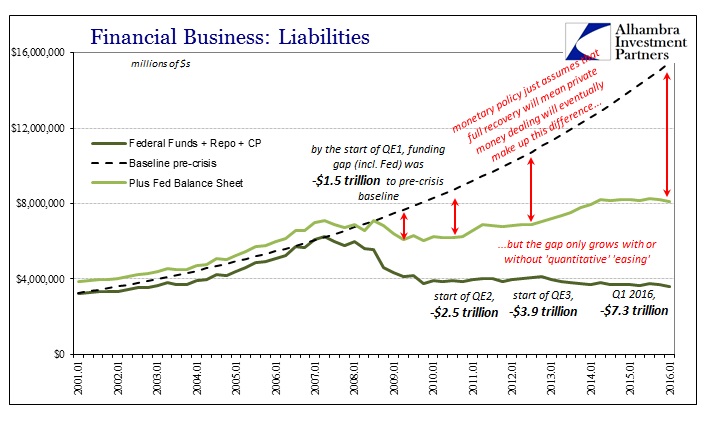
Never QE Fed BS CP plus FF repo plus Fed BS Baseline
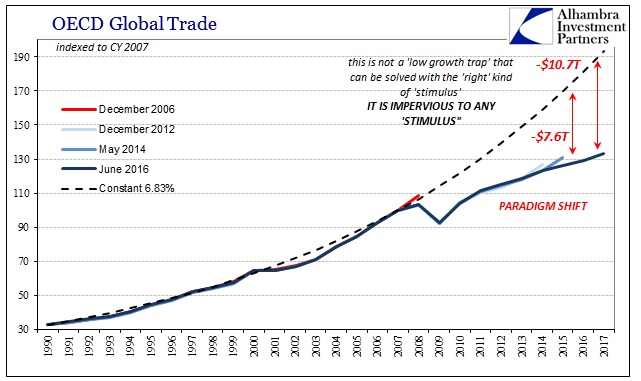
ABOOK June 2016 OECD Trillions
A comprehensive survey of our predicament isn’t universally bad, however. There are small fissures of hope taking the form of political revolt and populism, as I wrote earlier today. There was Brexit and now:
The light at the end of this tunnel is in the growing body of evidence that we are not yet Japan. The lost decades of the Japanese economy are both parts monetary criminality (“stimulus” after “stimulus” after “stimulus” with nothing ever being stimulated) but also political status quo to further entrench bad economics. Just this week, the Republican National Committee unveiled its commitment to restoring some type of Glass-Steagall. I have no idea how committed they really are, or exactly through what mechanism it might work, and I don’t really care. More important to me is the symbolism of even saying that they will do it and that banking (really money) is no longer a sacred political cow; recognizing just how far that is from TBTF.
In some ways it astounding it has taken this long; in other ways, in terms of glacial political shifts, it is amazing in only two presidential cycles just how far it has come. The last Republican President was committed to Too Big To Fail. That idea was birthed under cyclicality, where the Great Recession would be kept to a recession if Ben Bernanke and Hank Paulson got what they wanted and the awful ramifications of depression avoided by bailouts, monetarism, and the status quo. But we got the ramifications of depression anyway, showing yet again it was all a lie.
As much progress as this dramatic change may be, we aren’t nearly there yet. Central bankers are not anywhere close to having been brought to heel, and they have proved time and again they will not themselves stop. That actually creates something of a vacuum, a window actually for the most unpleasant opportunity:
The real danger of 2016 and immediately beyond, then, is this race; those that are catching up to the real problem and trying to find a real solution not of inflation or deflation but of stable money will need time to find and then implement it (this is where the lost opportunity of 2008 is so tragic). Against them are those who would impede intellectual growth (as what did happen in 2008). But as confidence in the old order falls and the strong populist desire to look elsewhere begins to take its place, into that messy void is still the potentially disruptive force of bad economics. Where do all these curves meet? In other words, what is the point at which shrinking faith, desperate central banks, and growing economic despair all conspire to push us into the darker reaches?
That is the real difference in 2016 – desperate central banks. They were (mostly) content to sit back in 2015 under expectations they formed from 2014. It was a big mistake in so many ways, not the least of which was growing suspicion from markets, even the stock markets (bank stocks as prime examples). They have rallied somewhat this year, with the ECB and now Bank of Japan leading – but all still in hope, not actual results. If this is a depression, and that is where all the evidence points, from GDP to labor to consumers, then this burst of desperation will have the same effect; nothing. Then what?
The narrative basis of my column was the German hyperinflationary episode of 1922 and 1923. I am not claiming that is the next step awaiting central bank bungling inside of the current depression, merely pointing out the commonalities of the situations that can lead to bigger, more intense problems of all kinds of bad possibilities.
In other words, German monetary officials, particularly Reichsbank head Rudolf von Havenstein and Minister of Finance Karl Helfferich, denied that Germany had an inflation problem at all – right up until the end. Minister Helfferich declared that Germany had better gold coverage after the war than before it, despite that more than quadrupling of currency volume. One economics professor, Julius Wolf, wrote in 1922 that, “in proportion to the need, less money circulates in Germany now than before the war.” As much as the easy-to-see Versailles excuse played a part, there can be no doubt that beyond 1921 the German people themselves began to recognize that authorities had no idea what they were doing; worse, they came to see that even though policymakers were inept and incompetent, officials themselves would never admit as much and thus nothing would prevent Germany from its fate. That awakening meant an increase in danger that French occupation could never have unleashed on its own. [emphasis added]
Confidence is truly a big part of economics (small “e”); that is why orthodox Economists (capital “E”) spend so much time with asset prices, infatuating themselves with bubbles while also convincing themselves they aren’t that. It isn’t something that can be conjured out of nothing, manipulated like a regression variable (raise stocks X, confidence increases Y, economy grows Z). But it can work in the other direction, such as when policymakers claim the “wealth effect” and then watch the economy instead sink. The real danger in terms of money and economy might be when the world wakes up to what I wrote above; policymakers have been calling a depression a recovery for nearly a decade. The implications of that might be where this possible event horizon sits; that central banks have exhausted themselves and we still got depression anyway.
I’d like to think that logic and reality will prevail; that distaste for being told how great the world is has become sufficiently revolting and obviously false to stir the world’s populace to end the imbalances. But that, again, will take time, perhaps a good deal of time; until then, whenever it hopefully is, central banks continue to operate with impunity even though the risks of their intemperance rise exponentially as time further accumulates and their claims fall further from reality. It’s not a good set of circumstances, especially since all QE did everywhere it was tried was show that confidence in it was sorely, disastrously misplaced.


Monday, April 11, 2016

The descent into depression...ongoing

Not to continue beating a dead horse, but I have a stick and the carcass is right in front of me. The entire supply chain inside the US economy is full agreement both on where the economy is right now and, perhaps more importantly, how it came to be that way. Such harmony is not atypical, as synchronicity usually defines the hard edges of any cycle. This, however, is something else entirely, especially as it stretches back years and confirms we are witnessing nothing like the usual.

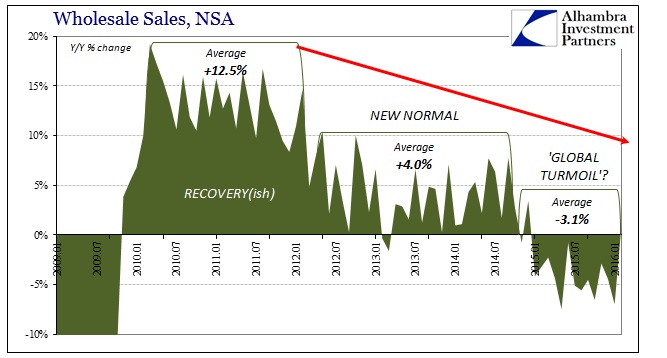
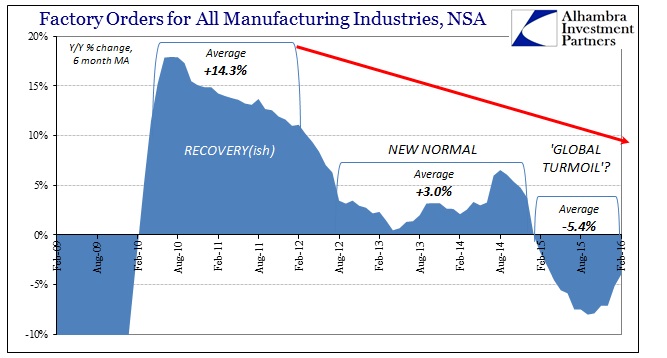
As it is, this latest part or phase or whatever has already taken up nearly two years. In terms of wholesale sales, as noted this morning, overall sales peaked in July 2014 – meaning nineteen months (thru Feb 2016) of deceleration into sustained contraction. Worse and what is probably the most concerning is that after those nineteen months inventory is only just now starting to correct, and it is doing so ever so gently. That suggests again slowdown without yet any visible end. In that sense, recession might actually be the best case since it would greatly speed up the affair in at least the convergence and reversion of inventory to sales (though that would still leave questions about the economic trend after it).

By comparison, the Great Recession featured just nine months of contraction; the whole of the dot-com recession twelve. Those were both top to bottom, peak to trough, over and done with.If you believe lies as are reported by the media and government. But use your common sense. Things SIMPLY JUST STEADILY GOTTEN WORSE FOR THE AVERAGE PERSON WITHOUT LETUP, YEAR AFTER YEAR. We've been in a downward cycle since the election of Bush II and anyone with an honest and functioning mind can see it.

In 2016, we are very likely facing two years and still only the beginning of reconciliation or balance, and no idea what that might mean further down in wider economic feedbacks and negative multipliers.
The supply chain, top to bottom:
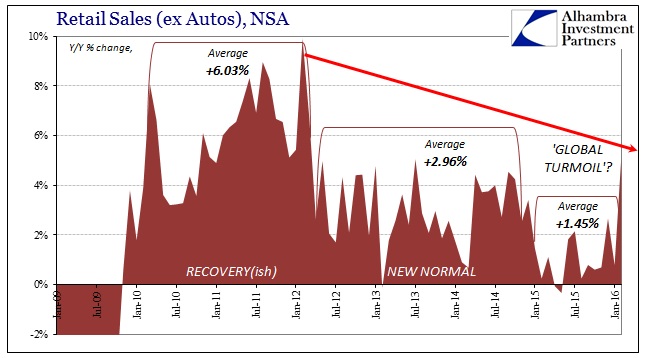
ABOOK Apr 2016 Boiling Frog Retail SalesABOOK Apr 2016 Slowdown Wholesale SalesABOOK Apr 2016 Boiling Frog Factory Orders

One other noteworthy interpretation: to find the “goods economy” including the whole of the supply chain in such joined, steady dislocation cannot be anything but a negative comment on the whole of the economy, services included. That starts with the fact that a significant portion (as much as half) of the “services economy” directly addresses the “goods economy” (retail, wholesale, transportation, etc.). Beyond that, if there is total breakdown in growth and advance in goods that can only mean a serious problem with US consumers. It has already forced economists and policymakers to completely abandon what was in late 2014 and early 2015 inarguable recovery and success. Just because it has not, so far, acted like recession does not propose a clean bill of health (just like it did not, last year, recommend this was all some temporary slump worthy of nothing but dismissal). Instead, that it has continued on for so long suggests quite the opposite, and, again, likely worse than just recession prospects in the long run.

 http://www.alhambrapartners.com/2016/04/08/supply-chain-slowdown/

Monday, March 28, 2016


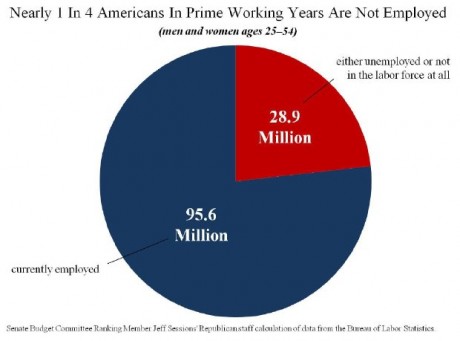
Americans In Their Prime Working Years Not Working
Higher degree of unemployed than during the ten years of the great depression. Making, as I've always said, this the GREATER DEPRESSION. Unless you are a vetted by the network, are a high end earning professional, or own a successful business. Everyone else? Kaboom. Although when I do see new hires in the trades they are either low paid Hispanics or well paid gays and lesbians because the word has gone forth to do so.

Friday, March 11, 2016

"Regarding the Great Depression. You're right, we did it. We're very sorry. But thanks to you, we won't do it again.' Ben Bernanke Nov. 2002

A lot of malnutrition and according to family members many deaths due to it. Although this is denied in historical texts. I think most people that lived through it wanted to forget it and put it behind them. Not realizing the same criminals that caused the depression had enslaved them through the Fed to keep their crimes going up until now. A lot of people even on here still refuse to admit it and will insist they are free.
Millennials don't feel bad these criminal have fooled most of the older generations and have been robbing people for millennia. Now they've stolen so much currency so far into the future they're going to have to kill a lot of people to cover it up. Which is why they would love to have another global war. They go by many names but are now commonly called globalists.

Think about it...what's really changed from then till now, other than that the media is hiding that we've been in a depression since 2008

Thursday, December 17, 2015

Money Velocity Is Crashing - Here's Why

The cause of the great depression wasn't the stock market, which recovered immediately in the following months, but rather the CONTRACTION OF THE MONEY SUPPLY AND CREDIT. In short, freezing the velocity of money. And it was intentional.

The inescapable conclusion is that Fed policies have effectively crashed the velocity of money.
That the velocity of money has been crashing while the money supply has been exploding doesn't seem to bother the mainstream pundits. There is always a fancy-footwork explanation of why whatever is crashing no longer matters.
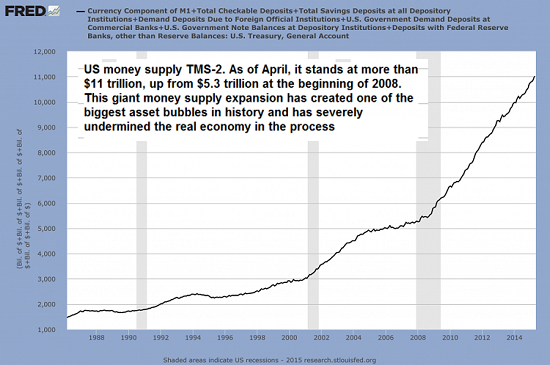
Take a look at these two charts and tell me money velocity doesn't matter. First, here's money supply: notice how money supply leaped from 2001 to 2008 as the Federal Reserve pumped liquidity and credit into the economy, and then how it exploded higher as the Fed went all in after the Global Financial Meltdown.

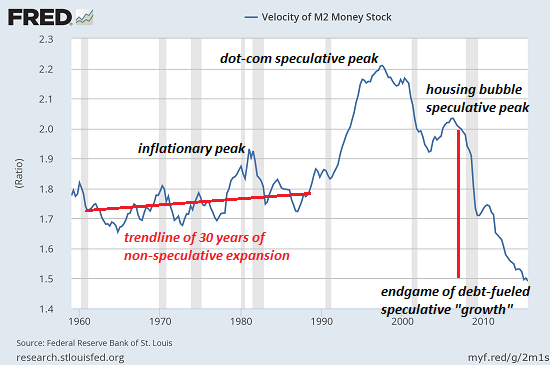
Now look at a brief history of the velocity of money. There are various measures of money supply and various interpretations of velocity, but let's set those quibbles aside and compare money velocity in the "golden era" of the 1950s/1960s and the stagflationary 1970s to the present era from 2008 to 2015--the era of "growth":

Notice how the velocity of money remained in a mild uptrend during both good times and not so good times. The inflationary peak of 1979-1982 (Treasury yields were 16% and mortgages were 18%) generated a spike, but velocity soon returned to its uptrending channel.
The speculative excesses of the dot-com era pushed velocity to unprecedented heights. Given the extremes in velocity, it is unsurprising that it quickly fell in the dot-com bust.
The Federal Reserve launched an unprecedented expansion of money, credit and liquidity that again pushed velocity up in the speculative frenzy of the housing bubble. But note that despite the vast expansion of money supply, the peak in the velocity of money was considerably lower than the dot-com peak.
Since the collapse of that speculative bubble, the Fed's all-in expansion of money, credit and liquidity has failed to stem the absolutely unprecedented collapse of money velocity. Clearly, expanding money, credit and liquidity no longer generates any velocity.
Rather, the inescapable conclusion is that Fed policies have effectively crashed the velocity of money. How is this possible?
Longtime correspondent Eric A. proposed an insightful explanation. Here is Eric's commentary:
"You know how you say that the economy is locked up in fiefdoms, and they're picking winners and losers, as part of colluding the prices? Well this adjustment of prices locks out certain people, like say, the young from housing. So houses don't sell, they stagnate.

But what are we really looking at? Velocity.

Velocity is an indicator that buyers and sellers agree on a price, that the price is "right" and not an outlier. That's why you see a stock move on high volume "confirming" the move, because it means the prices wasn't "right" at the previous level, while more people agree the new price is fair.

If prices are allowed to go where they need to without pressure and manipulation, you will always have velocity, as the most buyers and sellers will always agree at some price. Because this is true, low velocity cannot happen in a free market. Which means the only reason for low velocity (in this or the previous Depressions) is that someone has somehow managed to get an edge that prevents them from selling, from liquidating, at the true price, i.e. the one the buyers will agree to.

This has another corollary, that the measure of velocity on the Fed's own chart is the measure of the level of unnatural price manipulation on the market. We can watch this aggregate indicator of their failure in real time, by the Fed's own hand, and we can know the manipulation is ending when it rises.

So yes, the Fed, the governments, the insiders can manipulate to their heart's content, as they've been doing, but that unnatural pressure goes somewhere. And the pressure diverts into velocity. As we saw in the Great Depression, or the Roman Empire, velocity can stagnate for 10, 20, or 1,000 years until the manipulation ends, property rights are restored, and we have a free market.

History has shown that may be a bargain they're willing to make, but it won't do the rest of us a lot of good."

http://www.zerohedge.com/news/2015-12-17/money-velocity-crashing-heres-why