Showing posts with label gold shorting. Show all posts
Showing posts with label gold shorting. Show all posts
Thursday, January 21, 2016
Wednesday, July 29, 2015
4 Mainstream Media Articles Mocking Gold That Should Make You Think
Killing off the only safe haven for assets by ad hominem attacks and naked shorts, the satanic network is doing everything possible to prevent people from the precaution of wealth preservation. THis is a most deadly and serious omen that indeed, something wicked this way comes.
----------------------
Submitted by Mike Krieger via Liberty Blitzkrieg blog,
For those of you who have been reading my stuff since all the way back to my Wall Street years at Sanford Bernstein, thanks for staying along for the ride. I appreciate your support immensely considering that I essentially no longer write about financial markets at all, and for many of you, that remains your profession and primary area of interest.
There are many reasons why I stopped commenting on markets, but the main reason is that I started to recognize I wasn’t getting it right. In fact, in some cases I was getting it spectacularly wrong. Whenever this happens, I try to isolate the problem and fix it. In this case there was no fix, because much of why I was no longer getting it right was rooted in the fact that my heart, soul and passion had moved onto other things. My interests had expanded, and I started a blog to express myself on myriad other matters I deemed important. Providing relevant market information needs intense focus, and my focus had shifted elsewhere. I recognized that I wasn’t intellectually interested enough in centrally planned markets to provide insightful analysis, and so I stopped.
This doesn’t mean I won’t start up again. When central planners do lose control, I may indeed become far more interested in opining on such matters. Time will tell. In the interim, financial markets do still play an important role in the bigger picture of social, political and economic trends I passionately care about. The stability and increase in financial assets (stocks and bonds) is of huge importance to the propaganda machine, in particular keeping the non-oligarchic, non-politically connected 1% in line and believing the hype (see: The Stock Market: Food Stamps for the 1%).
So while I won’t claim to know when the paradigm shift will begin in earnest, I do rely on people who have gotten macro forecasts right, and there is no one better than Martin Armstrong. Years ago, he was saying that nothing goes up in a straight line and that gold would experience a severe correction before beginning its real bull market. We are seeing his prediction unfold before our very eyes. What he also said is that as gold approached the $1,000 per/oz mark or even below, everyone would proclaim that “gold is dead” and start making comically bearish statements. In a nutshell, negative sentiment would plunge to levels not seen in years, if not more than a decade. We are starting to see this now.
Here are four mainstream media articles that provide some evidence we may be approaching a sentiment low. Some of them I’m sure you’ve seen, others perhaps not. What amazes me is how they’ve all come out within the last two weeks.
1) From the Wall Street Journal: Let’s Be Honest About Gold: It’s a Pet Rock
Here are a few choice excerpts:
Moving on.
2) From the Washington Post: Gold is Doomed
Here are some examples:
Moving along to the next article:
3) From Bloomberg: Gold Is Only Going to Get Worse
4) From Market Watch: Two Reasons Why Gold May Plunge to $350 an Ounce.
Some choice quotes to think about:
While I certainly accept that gold prices could fall further from here, I don’t think they will go anywhere near $350/oz, or $500/oz. If Claude Erb cares to make a public bet with me on that, he can find me here.
----------------------
For those of you who have been reading my stuff since all the way back to my Wall Street years at Sanford Bernstein, thanks for staying along for the ride. I appreciate your support immensely considering that I essentially no longer write about financial markets at all, and for many of you, that remains your profession and primary area of interest.
There are many reasons why I stopped commenting on markets, but the main reason is that I started to recognize I wasn’t getting it right. In fact, in some cases I was getting it spectacularly wrong. Whenever this happens, I try to isolate the problem and fix it. In this case there was no fix, because much of why I was no longer getting it right was rooted in the fact that my heart, soul and passion had moved onto other things. My interests had expanded, and I started a blog to express myself on myriad other matters I deemed important. Providing relevant market information needs intense focus, and my focus had shifted elsewhere. I recognized that I wasn’t intellectually interested enough in centrally planned markets to provide insightful analysis, and so I stopped.
This doesn’t mean I won’t start up again. When central planners do lose control, I may indeed become far more interested in opining on such matters. Time will tell. In the interim, financial markets do still play an important role in the bigger picture of social, political and economic trends I passionately care about. The stability and increase in financial assets (stocks and bonds) is of huge importance to the propaganda machine, in particular keeping the non-oligarchic, non-politically connected 1% in line and believing the hype (see: The Stock Market: Food Stamps for the 1%).
So while I won’t claim to know when the paradigm shift will begin in earnest, I do rely on people who have gotten macro forecasts right, and there is no one better than Martin Armstrong. Years ago, he was saying that nothing goes up in a straight line and that gold would experience a severe correction before beginning its real bull market. We are seeing his prediction unfold before our very eyes. What he also said is that as gold approached the $1,000 per/oz mark or even below, everyone would proclaim that “gold is dead” and start making comically bearish statements. In a nutshell, negative sentiment would plunge to levels not seen in years, if not more than a decade. We are starting to see this now.
Here are four mainstream media articles that provide some evidence we may be approaching a sentiment low. Some of them I’m sure you’ve seen, others perhaps not. What amazes me is how they’ve all come out within the last two weeks.
1) From the Wall Street Journal: Let’s Be Honest About Gold: It’s a Pet Rock
Here are a few choice excerpts:
Gold is supposed to be a haven amid hard times and soft money. So why, even as Greece has defaulted, the euro has sunk against the dollar, and the Chinese stock market has stumbled, has gold been sitting there like a pet rock?Think about some of the words and phrases used in this WSJ article:
Many people may have bought gold for the wrong reasons: because of its glittering 18.7% average annual return between 2002 and 2011, because of its purportedly magical inflation-fighting properties, because it is supposed to shine in the darkest of days. But gold’s long-term returns are muted, it isn’t a panacea for inflation, and it does well in response to unexpected crises—but not long-simmering troubles like the Greek situation. And you will put lightning in a bottle before you figure out what gold is really worth.
With greenhorns in gold starting to figure all this out, the price has gotten tarnished. It is time to call owning gold what it is: an act of faith. As the Epistle to the Hebrews defined it forevermore, “Faith is the substance of things hoped for, the evidence of things not seen.” Own gold if you feel you must, but admit honestly that you are relying on hope and imagination.
Recognize, too, that gold bugs—the people who believe in owning the yellow metal no matter what—often resemble the subjects of a laboratory experiment on the psychology of cognitive dissonance.
So, if buying gold is an act of faith, how much money should you put on the line?
Anything much above that is more than an act of faith; it is a leap in the dark. Not even gold’s glitter can change that.
“Pet rock.”Condescending as the entire article is to gold owners, he even goes so far to quote the Hebrew Bible!
“Greenhorns in gold (greenhorn means a person who lacks experience and knowledge).”
“It is time to call owning gold what it is: an act of faith.”
“Gold bugs often resemble the subjects of a laboratory experiment on the psychology of cognitive dissonance (this is actually true in many ways).”
Moving on.
2) From the Washington Post: Gold is Doomed
When you think about it, a bet on gold is really a bet that the people in charge don’t know what they’re doing. Policymakers missed yesterday’s financial crisis, so maybe they’re missing tomorrow’s inflation, too. That, at least, is what a cavalcade of charlatans, cranks, and armchair economists have been shouting for years now, from the penny ads that run on the bottom of websites — did you know that the $5 bill proves the stock market is on the cusp of crashing? — to Glenn Beck infomercials and even hedge fund conferences. Indeed, John Paulson, who made more fortunes than you can count betting against subprime, has been piling into gold for six years now, because he thinks “the consequences of printing money over time will be inflation.” They all do. Goldbugs act like the Federal Reserve’s public balance sheet is a secret only they have discovered, and that it’s only a matter of time until prices explode like they did in the 1970s United States, if not 1920s Germany.While I agree that many gold bugs do deserve the criticism they get, it’s interesting to see the way in which the Washington Post demonizes them as:
But economists do, for the most part, know what they’re doing. Sure, they missed the crash coming in 2008, but that wasn’t because they didn’t understand how bank runs work. It was because they didn’t understand that unregulated lenders had become vulnerable to runs. And the economists who haven’t forgotten their history knew that this inflation fear mongering was all wrong too. Specifically, there’s a difference between the central bank buying bonds, a.k.a. printing money, when interest rates are zero and when they’re not. In the first case, money and short-term bonds both pay the same amount of interest — none — so, as Paul Krugman has explained over and over again, printing one to buy the other won’t change anything. Banks won’t lend out any new money, and will just sit on it as a store of value instead. That’s what happened when interest rates fell to zero in 2000s Japan, and it’s what is happening now in the U.S., U.K., Japan, and Europe.
It almost makes you feel bad for the goldbugs, until you remember that some substantial number of them are just trying to scare seniors out of their money. But the ones who aren’t really thought the 1970s showed that gold went up when inflation did, so the fact that gold was going up now meant inflation couldn’t be far behind. They didn’t understand that the price of gold doesn’t depend on how much inflation there is, but rather on how much inflation there is relative to interest rates. So now that rates are rising, gold, as you can see below, is falling. Wait a minute, rates are rising? Well, yes. The Federal Reserve hasn’t actually raised rates yet, but it has talked about it enough that markets have reacted as if it already did. That’s been enough to make real rates positive again.
“Just trying to scare seniors out of their money.”But the purpose of the above article is less about demonizing gold bugs, and more about praising the existing system of crank central planners that no one other than starry eyed pundits and thieving oligarchs actually support (see: “Revolution is Coming” – The Top 20 Responses to Jon Hilsenrath’s Idiotic WSJ Article).
Here are some examples:
But economists do, for the most part, know what they’re doing.This story is far from over, as the Fed has yet to raise interest rates. Talk to me about victory when rates normalize.
Paul Krugman has explained over and over again, printing one to buy the other won’t change anything.
Moving along to the next article:
3) From Bloomberg: Gold Is Only Going to Get Worse
The problem for gold isn’t just that prices are dropping. For many, the metal also has lost its charisma.Let’s once again highlight some of the terminology used.
Prices will drop to $984 an ounce before January, according to the average estimate in a Bloomberg News survey of 16 analysts and traders. That would be the lowest since 2009 and a 10 percent retreat from Tuesday’s settlement. Speculators are shorting the metal for the first time since U.S. government data began in 2006, and holders of exchange-traded products are selling at the fastest pace in two years.
“Gold is out of fashion like flared trousers: no one wants it,” said Robin Bhar, an analyst at Societe Generale SA in London. “It’s not going to collapse, but we think it is going to be at a lower level in the not-too-distant future.”
“Gold is a weird relic of antiquity,” said Brian Barish, who helps oversee about $12.5 billion at Denver-based Cambiar Investors LLC. “It’s not a commodity that has much fundamental demand. It’s pretty, so people use it for jewelry. But it’s unlike iron ore or oil, or copper, or corn. There’s not specific end-use for it. People just like it, so it becomes a discussion about fervor.”
The metal also has lost its charismaSo now it’s magically turned into a human being as opposed to a pet rock.
Speculators are shorting the metal for the first time since U.S. government data began in 2006Finally, for the last article. This one takes on more of the tone from the WSJ article, basically just calling gold buyers imbeciles.
“Gold is out of fashion like flared trousers: no one wants it.
“Gold is a weird relic of antiquity.”
4) From Market Watch: Two Reasons Why Gold May Plunge to $350 an Ounce.
CHAPEL HILL, N.C. (MarketWatch) — Gold bugs, who have just begun to digest bullion’s more than $100 drop over the past month, need to prepare for the possibility of an even bigger decline.
That, at least, is the forecast of Claude Erb, a former commodities manager at fund manager TCW Group, and co-author (with Campbell Harvey, a Duke University finance professor) of a mid-2012 study that forecast a plunging gold price. They deserve to be listened to, therefore, since — unlike many latter-day converts to the bearish thesis — they forecast a long-term gold bear market when it was only just beginning.
You might think that, with gold now trading more than $500 lower than when the study was released, Erb would declare victory and leave well enough alone. But Erb is doing nothing of the sort. Earlier this week, he told me that the gold community now needs to consider the distinct possibility that gold will trade for as low as $350 an ounce.
Erb uses the five well-know stages of grief to characterize where the gold market currently stands. Those stages are denial, anger, bargaining, depression and acceptance, and he argues that the gold-bug community currently is in the “bargaining” stage.
Erb imagines them saying the functional equivalent of: “So long as gold stays above $1,000 an ounce, I’ll go to church every Sunday.”
Over shorter terms measured in years, according to their research, you must take seriously the possibility that gold won’t just drop below $1,000 an ounce but, eventually, to a far, far lower price as well.
The gold community now needs to consider the distinct possibility that gold will trade for as low as $350 an ounce.This is pretty much peak condescension, and once again, notice the religious imagery.
Erb uses the five well-know stages of grief to characterize where the gold market currently stands.
“So long as gold stays above $1,000 an ounce, I’ll go to church every Sunday.”
Gold won’t just drop below $1,000 an ounce but, eventually, to a far, far lower price as well.I didn’t write this article to “call the bottom in gold” or anything like that. I merely want to flag these four articles due to the hyperbolic nature of some of the statements made (they are exhibiting pretty much exactly the same behavior as the gold bugs they mock do). I do think that something is happening on the sentiment front that warrants we are closer to the bottom that the mid-stages of a bear market.
While I certainly accept that gold prices could fall further from here, I don’t think they will go anywhere near $350/oz, or $500/oz. If Claude Erb cares to make a public bet with me on that, he can find me here.

Tuesday, July 28, 2015
The manipulation of the gold price by injecting large quantities of freshly printed NAKED SHORTS into the Comex market is an empirical fact. The sudden debunking of gold in the financial press is circumstantial evidence that a full-scale attack on gold’s function as a systemic warning signal is underway.
thored by Paul Craig Roberts and Dave Kranzler,
This article establishes that the price of gold and silver in the futures markets in which cash is the predominant means of settlement is inconsistent with the conditions of supply and demand in the actual physical or current market where physical bullion is bought and sold as opposed to transactions in uncovered paper claims to bullion in the futures markets. The supply of bullion in the futures markets is increased by printing uncovered contracts representing claims to gold. This artificial, indeed fraudulent, increase in the supply of paper bullion contracts drives down the price in the futures market despite high demand for bullion in the physical market and constrained supply. We will demonstrate with economic analysis and empirical evidence that the bear market in bullion is an artificial creation.
The law of supply and demand is the basis of economics. Yet the price of gold and silver in the Comex futures market, where paper contracts representing 100 troy ounces of gold or 5,000 ounces of silver are traded, is inconsistent with the actual supply and demand conditions in the physical market for bullion. For four years the price of bullion has been falling in the futures market despite rising demand for possession of the physical metal and supply constraints.
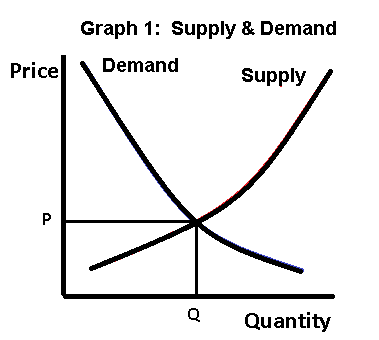
We begin with a review of basics. The vertical axis measures price. The horizontal axis measures quantity. Demand curves slope down to the right, the quantity demanded increasing as price falls. Supply curves slope upward to the right, the quantity supplied rising with price. The intersection of supply with demand determines price. (Graph 1)
A change in quantity demanded or in the quantity supplied refers to a movement along a given curve. A change in demand or a change in supply refers to a shift in the curves. For example, an increase in demand (a shift to the right of the demand curve) causes a movement along the supply curve (an increase in the quantity supplied).
Changes in income and changes in tastes or preferences toward an item can cause the demand curve to shift. For example, if people expect that their fiat currency is going to lose value, the demand for gold and silver would increase (a shift to the right).
Changes in technology and resources can cause the supply curve to shift. New gold discoveries and improvements in gold mining technology would cause the supply curve to shift to the right. Exhaustion of existing mines would cause a reduction in supply (a shift to the left).
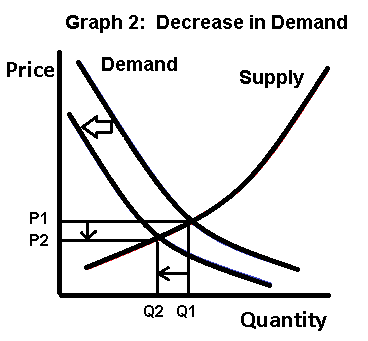
What can cause the price of gold to fall? Two things: The demand for gold can fall, that is, the demand curve could shift to the left, intersecting the supply curve at a lower price. The fall in demand results in a reduction in the quantity supplied. A fall in demand means that people want less gold at every price. (Graph 2)
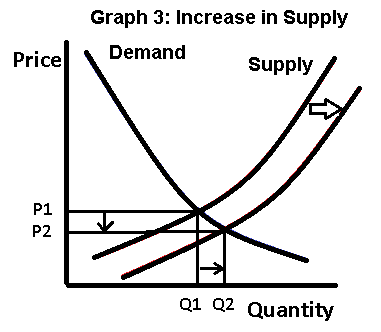
Alternatively, supply could increase, that is, the supply curve could shift to the right, intersecting the demand curve at a lower price. The increase in supply results in an increase in the quantity demanded. An increase in supply means that more gold is available at every price. (Graph 3)
To summarize: a decline in the price of gold can be caused by a decline in the demand for gold or by an increase in the supply of gold.
A decline in demand or an increase in supply is not what we are observing in the gold and silver physical markets. The price of bullion in the futures market has been falling as demand for physical bullion increases and supply experiences constraints. What we are seeing in the physical market indicates a rising price. Yet in the futures market in which almost all contracts are settled in cash and not with bullion deliveries, the price is falling.
For example, on July 7, 2015, the U.S. Mint said that due to a “significant” increase in demand, it had sold out of Silver Eagles (one ounce silver coin) and was suspending sales until some time in August. The premiums on the coins (the price of the coin above the price of the silver) rose, but the spot price of silver fell 7 percent to its lowest level of the year (as of July 7).
This is the second time in 9 months that the U.S. Mint could not keep up with market demand and had to suspend sales. During the first 5 months of 2015, the U.S. Mint had to ration sales of Silver Eagles. According to Reuters, since 2013 the U.S. Mint has had to ration silver coin sales for 18 months. In 2013 the Royal Canadian Mint announced the rationing of its Silver Maple Leaf coins: “We are carefully managing supply in the face of very high demand. . . . Coming off strong sales volumes in December 2012, demand to date remains very strong for our Silver Maple Leaf and Gold Maple Leaf bullion coins.” During this entire period when mints could not keep up with demand for coins, the price of silver consistently fell on the Comex futures market. On July 24, 2015 the price of gold in the futures market fell to its lowest level in 5 years despite an increase in the demand for gold in the physical market. On that day U.S. Mint sales of Gold Eagles (one ounce gold coin) were the highest in more than two years, yet the price of gold fell in the futures market.
How can this be explained? The financial press says that the drop in precious metals prices unleashed a surge in global demand for coins. This explanation is nonsensical to an economist. Price is not a determinant of demand but of quantity demanded. A lower price does not shift the demand curve. Moreover, if demand increases, price goes up, not down.
Perhaps what the financial press means is that the lower price resulted in an increase in the quantity demanded. If so, what caused the lower price? In economic analysis, the answer would have to be an increase in supply, either new supplies from new discoveries and new mines or mining technology advances that lower the cost of producing bullion.
There are no reports of any such supply increasing developments. To the contrary, the lower prices of bullion have been causing reductions in mining output as falling prices make existing operations unprofitable.
There are abundant other signs of high demand for bullion, yet the prices continue their four-year decline on the Comex. Even as massive uncovered shorts (sales of gold contracts that are not covered by physical bullion) on the bullion futures market are driving down price, strong demand for physical bullion has been depleting the holdings of GLD, the largest exchange traded gold fund. Since February 27, 2015, the authorized bullion banks (principally JPMorganChase, HSBC, and Scotia) have removed 10 percent of GLD’s gold holdings. Similarly, strong demand in China and India has resulted in a 19% increase of purchases from the Shanghai Gold Exchange, a physical bullion market, during the first quarter of 2015. Through the week ending July 10, 2015, purchases from the Shanghai Gold Exchange alone are occurring at an annualized rate approximately equal to the annual supply of global mining output.
India’s silver imports for the first four months of 2015 are 30% higher than 2014. In the first quarter of 2015 Canadian Silver Maple Leaf sales increased 8.5% compared to sales for the same period of 2014. Sales of Gold Eagles in June, 2015, were more than triple the sales for May. During the first 10 days of July, Gold Eagles sales were 2.5 times greater than during the first 10 days of June.
Clearly the demand for physical metal is very high, and the ability to meet this demand is constrained. Yet, the prices of bullion in the futures market have consistently fallen during this entire period. The only possible explanation is manipulation.
Precious metal prices are determined in the futures market, where paper contracts representing bullion are settled in cash, not in markets where the actual metals are bought and sold. As the Comex is predominantly a cash settlement market, there is little risk in uncovered contracts (an uncovered contract is a promise to deliver gold that the seller of the contract does not possess). This means that it is easy to increase the supply of gold in the futures market where price is established simply by printing uncovered (naked) contracts. Selling naked shorts is a way to artificially increase the supply of bullion in the futures market where price is determined. The supply of paper contracts representing gold increases, but not the supply of physical bullion.
As we have documented on a number of occasions, the prices of bullion are being systematically driven down by the sudden appearance and sale during thinly traded times of day and night of uncovered future contracts representing massive amounts of bullion. In the space of a few minutes or less massive amounts of gold and silver shorts are dumped into the Comex market, dramatically increasing the supply of paper claims to bullion. If purchasers of these shorts stood for delivery, the Comex would fail. Comex bullion futures are used for speculation and by hedge funds to manage the risk/return characteristics of metrics like the Sharpe Ratio. The hedge funds are concerned with indexing the price of gold and silver and not with the rate of return performance of their bullion contracts.
A rational speculator faced with strong demand for bullion and constrained supply would not short the market. Moreover, no rational actor who wished to unwind a large gold position would dump the entirety of his position on the market all at once. What then explains the massive naked shorts that are hurled into the market during thinly traded times?
The bullion banks are the primary market-makers in bullion futures. They are also clearing members of the Comex, which gives them access to data such as the positions of the hedge funds and the prices at which stop-loss orders are triggered. They time their sales of uncovered shorts to trigger stop-loss sales and then cover their short sales by purchasing contracts at the price that they have forced down, pocketing the profits from the manipulation
The manipulation is obvious. The question is why do the authorities tolerate it?
Perhaps the answer is that a free gold market serves both to protect against the loss of a fiat currency’s purchasing power from exchange rate decline and inflation and as a warning that destabilizing systemic events are on the horizon. The current round of on-going massive short sales compressed into a few minutes during thinly traded periods began after gold hit $1,900 per ounce in response to the build-up of troubled debt and the Federal Reserve’s policy of Quantitative Easing. Washington’s power is heavily dependent on the role of the dollar as world reserve currency. The rising dollar price of gold indicated rising discomfort with the dollar. Whereas the dollar’s exchange value is carefully managed with help from the Japanese and European central banks, the supply of such help is not unlimited. If gold kept moving up, exchange rate weakness was likely to show up in the dollar, thus forcing the Fed off its policy of using QE to rescue the “banks too big to fail.”
The bullion banks’ attack on gold is being augmented with a spate of stories in the financial media denying any usefulness of gold. On July 17 the Wall Street Journal declared that honesty about gold requires recognition that gold is nothing but a pet rock. Other commentators declare gold to be in a bear market despite the strong demand for physical metal and supply constraints, and some influential party is determined that gold not be regarded as money.
Why a sudden spate of claims that gold is not money? Gold is considered a part of the United States’ official monetary reserves, which is also the case for central banks and the IMF. The IMF accepts gold as repayment for credit extended. The US Treasury’s Office of the Comptroller of the Currency classifies gold as a currency, as can be seen in the OCC’s latest quarterly report on bank derivatives activities in which the OCC places gold futures in the foreign exchange derivatives classification.
The manipulation of the gold price by injecting large quantities of freshly printed uncovered contracts into the Comex market is an empirical fact. The sudden debunking of gold in the financial press is circumstantial evidence that a full-scale attack on gold’s function as a systemic warning signal is underway.
It is unlikely that regulatory authorities are unaware of the fraudulent manipulation of bullion prices. The fact that nothing is done about it is an indication of the lawlessness that prevails in US financial markets.
This article establishes that the price of gold and silver in the futures markets in which cash is the predominant means of settlement is inconsistent with the conditions of supply and demand in the actual physical or current market where physical bullion is bought and sold as opposed to transactions in uncovered paper claims to bullion in the futures markets. The supply of bullion in the futures markets is increased by printing uncovered contracts representing claims to gold. This artificial, indeed fraudulent, increase in the supply of paper bullion contracts drives down the price in the futures market despite high demand for bullion in the physical market and constrained supply. We will demonstrate with economic analysis and empirical evidence that the bear market in bullion is an artificial creation.
The law of supply and demand is the basis of economics. Yet the price of gold and silver in the Comex futures market, where paper contracts representing 100 troy ounces of gold or 5,000 ounces of silver are traded, is inconsistent with the actual supply and demand conditions in the physical market for bullion. For four years the price of bullion has been falling in the futures market despite rising demand for possession of the physical metal and supply constraints.
We begin with a review of basics. The vertical axis measures price. The horizontal axis measures quantity. Demand curves slope down to the right, the quantity demanded increasing as price falls. Supply curves slope upward to the right, the quantity supplied rising with price. The intersection of supply with demand determines price. (Graph 1)
A change in quantity demanded or in the quantity supplied refers to a movement along a given curve. A change in demand or a change in supply refers to a shift in the curves. For example, an increase in demand (a shift to the right of the demand curve) causes a movement along the supply curve (an increase in the quantity supplied).
Changes in income and changes in tastes or preferences toward an item can cause the demand curve to shift. For example, if people expect that their fiat currency is going to lose value, the demand for gold and silver would increase (a shift to the right).
Changes in technology and resources can cause the supply curve to shift. New gold discoveries and improvements in gold mining technology would cause the supply curve to shift to the right. Exhaustion of existing mines would cause a reduction in supply (a shift to the left).
What can cause the price of gold to fall? Two things: The demand for gold can fall, that is, the demand curve could shift to the left, intersecting the supply curve at a lower price. The fall in demand results in a reduction in the quantity supplied. A fall in demand means that people want less gold at every price. (Graph 2)
Alternatively, supply could increase, that is, the supply curve could shift to the right, intersecting the demand curve at a lower price. The increase in supply results in an increase in the quantity demanded. An increase in supply means that more gold is available at every price. (Graph 3)
To summarize: a decline in the price of gold can be caused by a decline in the demand for gold or by an increase in the supply of gold.
A decline in demand or an increase in supply is not what we are observing in the gold and silver physical markets. The price of bullion in the futures market has been falling as demand for physical bullion increases and supply experiences constraints. What we are seeing in the physical market indicates a rising price. Yet in the futures market in which almost all contracts are settled in cash and not with bullion deliveries, the price is falling.
For example, on July 7, 2015, the U.S. Mint said that due to a “significant” increase in demand, it had sold out of Silver Eagles (one ounce silver coin) and was suspending sales until some time in August. The premiums on the coins (the price of the coin above the price of the silver) rose, but the spot price of silver fell 7 percent to its lowest level of the year (as of July 7).
This is the second time in 9 months that the U.S. Mint could not keep up with market demand and had to suspend sales. During the first 5 months of 2015, the U.S. Mint had to ration sales of Silver Eagles. According to Reuters, since 2013 the U.S. Mint has had to ration silver coin sales for 18 months. In 2013 the Royal Canadian Mint announced the rationing of its Silver Maple Leaf coins: “We are carefully managing supply in the face of very high demand. . . . Coming off strong sales volumes in December 2012, demand to date remains very strong for our Silver Maple Leaf and Gold Maple Leaf bullion coins.” During this entire period when mints could not keep up with demand for coins, the price of silver consistently fell on the Comex futures market. On July 24, 2015 the price of gold in the futures market fell to its lowest level in 5 years despite an increase in the demand for gold in the physical market. On that day U.S. Mint sales of Gold Eagles (one ounce gold coin) were the highest in more than two years, yet the price of gold fell in the futures market.
How can this be explained? The financial press says that the drop in precious metals prices unleashed a surge in global demand for coins. This explanation is nonsensical to an economist. Price is not a determinant of demand but of quantity demanded. A lower price does not shift the demand curve. Moreover, if demand increases, price goes up, not down.
Perhaps what the financial press means is that the lower price resulted in an increase in the quantity demanded. If so, what caused the lower price? In economic analysis, the answer would have to be an increase in supply, either new supplies from new discoveries and new mines or mining technology advances that lower the cost of producing bullion.
There are no reports of any such supply increasing developments. To the contrary, the lower prices of bullion have been causing reductions in mining output as falling prices make existing operations unprofitable.
There are abundant other signs of high demand for bullion, yet the prices continue their four-year decline on the Comex. Even as massive uncovered shorts (sales of gold contracts that are not covered by physical bullion) on the bullion futures market are driving down price, strong demand for physical bullion has been depleting the holdings of GLD, the largest exchange traded gold fund. Since February 27, 2015, the authorized bullion banks (principally JPMorganChase, HSBC, and Scotia) have removed 10 percent of GLD’s gold holdings. Similarly, strong demand in China and India has resulted in a 19% increase of purchases from the Shanghai Gold Exchange, a physical bullion market, during the first quarter of 2015. Through the week ending July 10, 2015, purchases from the Shanghai Gold Exchange alone are occurring at an annualized rate approximately equal to the annual supply of global mining output.
India’s silver imports for the first four months of 2015 are 30% higher than 2014. In the first quarter of 2015 Canadian Silver Maple Leaf sales increased 8.5% compared to sales for the same period of 2014. Sales of Gold Eagles in June, 2015, were more than triple the sales for May. During the first 10 days of July, Gold Eagles sales were 2.5 times greater than during the first 10 days of June.
Clearly the demand for physical metal is very high, and the ability to meet this demand is constrained. Yet, the prices of bullion in the futures market have consistently fallen during this entire period. The only possible explanation is manipulation.
Precious metal prices are determined in the futures market, where paper contracts representing bullion are settled in cash, not in markets where the actual metals are bought and sold. As the Comex is predominantly a cash settlement market, there is little risk in uncovered contracts (an uncovered contract is a promise to deliver gold that the seller of the contract does not possess). This means that it is easy to increase the supply of gold in the futures market where price is established simply by printing uncovered (naked) contracts. Selling naked shorts is a way to artificially increase the supply of bullion in the futures market where price is determined. The supply of paper contracts representing gold increases, but not the supply of physical bullion.
As we have documented on a number of occasions, the prices of bullion are being systematically driven down by the sudden appearance and sale during thinly traded times of day and night of uncovered future contracts representing massive amounts of bullion. In the space of a few minutes or less massive amounts of gold and silver shorts are dumped into the Comex market, dramatically increasing the supply of paper claims to bullion. If purchasers of these shorts stood for delivery, the Comex would fail. Comex bullion futures are used for speculation and by hedge funds to manage the risk/return characteristics of metrics like the Sharpe Ratio. The hedge funds are concerned with indexing the price of gold and silver and not with the rate of return performance of their bullion contracts.
A rational speculator faced with strong demand for bullion and constrained supply would not short the market. Moreover, no rational actor who wished to unwind a large gold position would dump the entirety of his position on the market all at once. What then explains the massive naked shorts that are hurled into the market during thinly traded times?
The bullion banks are the primary market-makers in bullion futures. They are also clearing members of the Comex, which gives them access to data such as the positions of the hedge funds and the prices at which stop-loss orders are triggered. They time their sales of uncovered shorts to trigger stop-loss sales and then cover their short sales by purchasing contracts at the price that they have forced down, pocketing the profits from the manipulation
The manipulation is obvious. The question is why do the authorities tolerate it?
Perhaps the answer is that a free gold market serves both to protect against the loss of a fiat currency’s purchasing power from exchange rate decline and inflation and as a warning that destabilizing systemic events are on the horizon. The current round of on-going massive short sales compressed into a few minutes during thinly traded periods began after gold hit $1,900 per ounce in response to the build-up of troubled debt and the Federal Reserve’s policy of Quantitative Easing. Washington’s power is heavily dependent on the role of the dollar as world reserve currency. The rising dollar price of gold indicated rising discomfort with the dollar. Whereas the dollar’s exchange value is carefully managed with help from the Japanese and European central banks, the supply of such help is not unlimited. If gold kept moving up, exchange rate weakness was likely to show up in the dollar, thus forcing the Fed off its policy of using QE to rescue the “banks too big to fail.”
The bullion banks’ attack on gold is being augmented with a spate of stories in the financial media denying any usefulness of gold. On July 17 the Wall Street Journal declared that honesty about gold requires recognition that gold is nothing but a pet rock. Other commentators declare gold to be in a bear market despite the strong demand for physical metal and supply constraints, and some influential party is determined that gold not be regarded as money.
Why a sudden spate of claims that gold is not money? Gold is considered a part of the United States’ official monetary reserves, which is also the case for central banks and the IMF. The IMF accepts gold as repayment for credit extended. The US Treasury’s Office of the Comptroller of the Currency classifies gold as a currency, as can be seen in the OCC’s latest quarterly report on bank derivatives activities in which the OCC places gold futures in the foreign exchange derivatives classification.
The manipulation of the gold price by injecting large quantities of freshly printed uncovered contracts into the Comex market is an empirical fact. The sudden debunking of gold in the financial press is circumstantial evidence that a full-scale attack on gold’s function as a systemic warning signal is underway.
It is unlikely that regulatory authorities are unaware of the fraudulent manipulation of bullion prices. The fact that nothing is done about it is an indication of the lawlessness that prevails in US financial markets.
Subscribe to:
Posts (Atom)