I
know what you must be thinking here: “How the hell could you leave
Francis Tumblety out of the previous post? Compared to him, guys like
Boston Corbett, Henry Rathbone and Edwin Stanton seem perfectly sane.
And whose name was in the news in a weirder way in the years following
the assassination than the esteemed Dr. Francis Tumblety? And in
addition, doesn’t he deserve honorable mention for the ridiculous facial
hair alone?”
I can’t really argue much with any of
that. I think it was probably a subconscious omission so that I would
have something really good to start this post with. Because as stories
go, the Francis Tumblety story is pretty damn good. And seriously
strange. But before getting to that, I must also quickly add Father
Wiget to the list. Not much can be dug up on him other than that he was
assigned as Mary Surrat’s spiritual adviser during the brief period that
she sat in her cell waiting to be executed, and he died shortly
thereafter.
Moving on now to the man of the hour,
Francis Tumblety was arrested on May 5, 1865, on suspicion of being
complicit in the plot to assassinate Abraham Lincoln. Tumblety was an
associate of – and by some reports a sometime employer of – executed
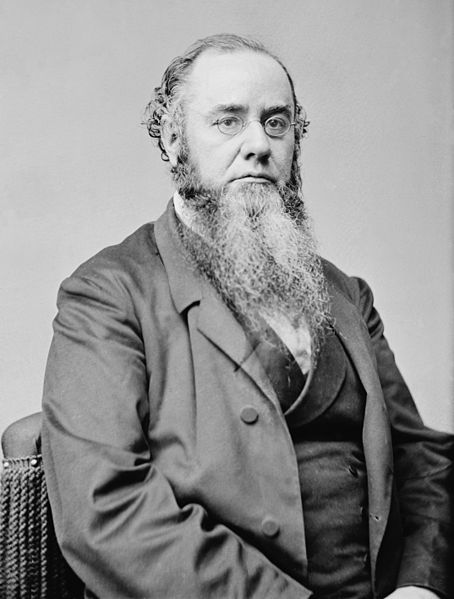
conspirator David Herold. His arrest was ordered by Secretary of War
Edwin Stanton. To be fair to Tumblety though, it should be noted that he
was only one of some 2,000 people who were arrested as possible
conspirators. That’s how things work in a democracy, you see – falsely
imprison first, ask questions later.
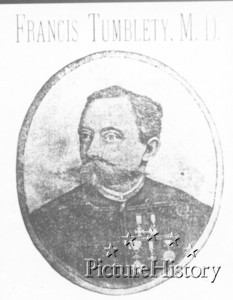
The esteemed Dr. Francis Tumblety
In
any event, Tumblety was held for nearly a month before being released
on May 30, 1865. Prior to his arrest, he had lived a very colorful life.
Born circa 1833 and raised in New York, Tumblety was widely viewed as a
charlatan and a kook. While still a minor, he reportedly peddled
pornographic materials. He soon transformed into a quack “Indian herb
doctor” who was run out of various parts of the country for running
cons. In one reported case, he was directly involved in the death of a
‘patient,’ though he suffered no repercussions for his actions.
According to one account, he kept a collection of human uteruses on
display in his Washington, DC home.
Some
twenty-three years after his arrest in Washington, Tumblety took up
lodging in, of all places, a boardinghouse in London’s Whitechapel
district. He was identified at that time, and has been identified by
various researchers since that time, as being a prime suspect in the
still unsolved Jack the Ripper murders. Following an arrest on November
7, 1888 for “gross indecency,” Tumblety fled the country on November 20
under an assumed name and quickly made his way back to the US, where he
died some five years later.
What are the odds, one
wonders, that the very same guy would be suspected of involvement in two
such completely different and seemingly unconnected crimes? Two crimes
separated by a vast ocean and the passage of nearly two-and-a-half
decades? Probably about the same odds that a guy like John Phillips would have connections to both the Black Dahlia murder and the Manson bloodbath.
*******************************************************
Pictured
below is the single-shot derringer that, according to the legend we all
know so well, John Wilkes Booth used to assassinate President Abraham
Lincoln. One of the most iconic pieces of historical memorabilia that
this country has to offer, it has been displayed for decades, viewed by
millions, and written about by thousands. But after the passage of 149
years, it doesn’t appear that anyone has ever thought to question why
Booth, an intelligent and educated man by all accounts, would choose
such a ridiculous weapon to take with him on his mission.
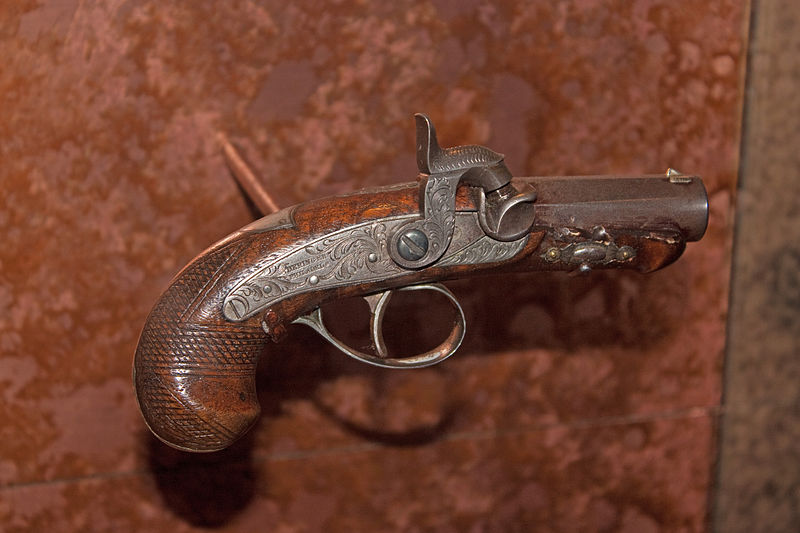
Let’s
imagine that it is the evening of April 14, 1865, and you are John
Wilkes Booth. Your mission is to assassinate the president. In a crowded
theater. In the middle of Washington, which, at the time, is heavily
fortified and militarized. Because there is, you know, a war going on.
And the enemy’s base of operations – in Richmond, Virginia – is only 100
miles away. So the nation’s capital is crawling with armed military
personnel, armed police patrols, and armed thugs in the employ of Baker
and Stanton.
Your mission then is not going to be
an easy one. The president is under armed guard, or at least he’s
supposed to be. He’s also supposed to be in the company of General
Ulysses S. Grant, who is known to always be armed. Of course, Grant has
fortuitously opted to get the hell out of Dodge just hours before he was
to have accompanied the Lincolns to the theater, but you shouldn’t have
any way of knowing that, just as you shouldn’t have any way of knowing
that Parker will desert his post. And there will be no shortage of other
armed personnel in Ford’s Theater, including Army Captain Theodore
McGowan (no relation), who is seated very near the door to Lincoln’s box
seats.
So you have to assume that you’re going to
have to get past at least two armed attendants, and probably more, to
get to the president. And you’re going to have to do that without firing
a shot, since you only have one and you will need to save that for Abe.
And since the only realistic chance you have of actually
killing Lincoln with your wildly inaccurate weapon is by sneaking up
behind him and delivering a contact wound to his head, you’re going to
have to get past any guards without making any noise. And since Grant is
supposedly also on the hit list, you’re going to have to kill him as
well, which I guess you’ll have to do by bludgeoning him with your empty
gun. That should work out pretty well.
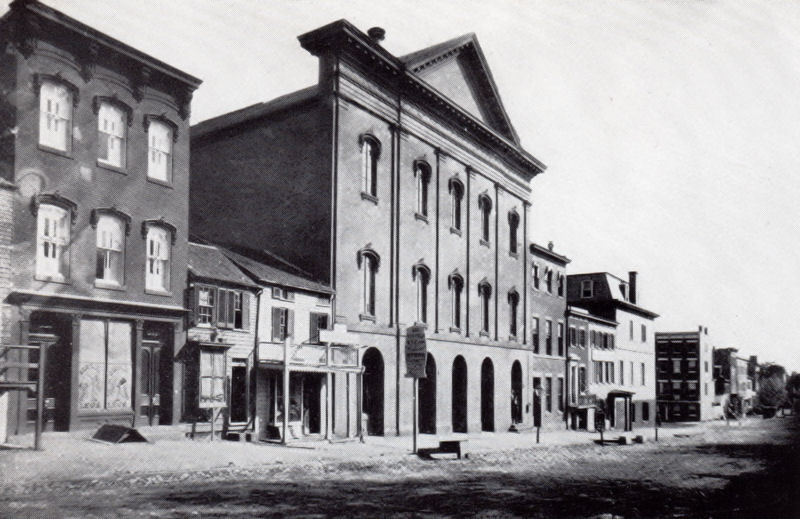
Ford’s Theater, circa 1865
You’re
not on a suicide mission, by the way, so even if you somehow manage to
successfully assassinate the president, and presumably General Grant as
well, you’re still going to have some major problems on your hands.
First of all, you’re going to have to make your escape from a theater
full of people, many of them armed. Because in April 1865, the beginning
of the era that will be mythologized as the ‘Wild West’ days, there are
guns everywhere and everyone is packing heat. And you, of course, will
have blown your wad and will be unarmed.
If you
somehow manage to make your way out of the theater, then you will face
the daunting prospect of making your way out of the city and across
the Potomac. And as I may have mentioned, DC is swarming with armed
soldiers, armed spies and armed police, as well as armed citizens. And
your only means of defending yourself will be with a dagger, which
probably isn’t going to be very effective.
Your
goal is to reach the Navy Yard Bridge, which will get you across
the Potomac and to relative safety. But even if you reach it, you’ve
still got a big hurdle to overcome: the bridge has a strict curfew and
the armed guard is under standing orders not to allow anyone to cross
without explicit authorization. If you attempt to cross without anyway,
you will be shot. A gun might come in handy, but you won’t have one.
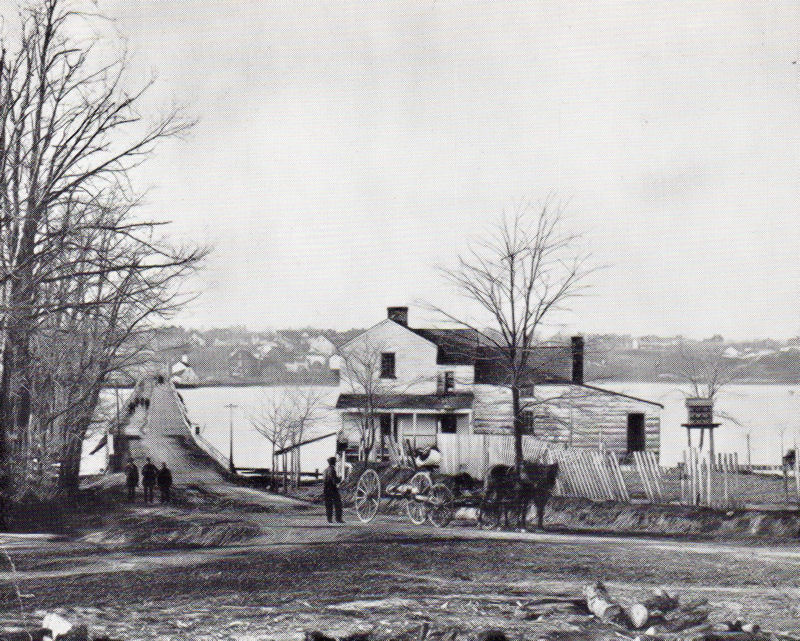
The Navy Yard Bridge, John Wilkes Booth’s passage out of town
To
recap then, you have set a very ambitious goal for yourself. You must
first get to the president, who is sitting in a private box in a crowded
theater with at least two armed attendants. You must then kill the
president with a single shot, because your weapon doesn’t allow for
second chances, and also somehow kill General Grant. You must then, in
an unarmed state, make an escape first from the theater and then from
the city, and you must get past an armed guard at the bridge. And you
have to do all of that with just one bullet. It’s hard to see how
anything could go wrong with such a brilliant plan.
Of
course, it doesn’t have to be this way. There are other weapons
available. Weapons better suited to your mission. And as an alleged
Southern operative, you should surely know that. It was, after all,
Confederate guerilla groups that pioneered the shock-and-awe tactic of
using overwhelming force in the form of multiple revolvers. We’ve all
seen images of Wild West gunslingers riding hard with their reins in
their teeth, six-shooters blazing in both hands. It’s only natural to
dismiss such images as a hackneyed Hollywood creation. But strangely
enough, it’s actually not. Rebel groups like Mosby’s Rangers and
Quantrill’s Raiders really did train to do exactly that. And they wore
custom-made holsters that could hold as many as six revolvers, three on
each side. That allowed them to get off as many as 36 shots before their
overwhelmed Union adversaries, armed with muskets, could reload and get
off so much as a second shot.
Those semi-mythical
figures in American history that we know as Frank and Jesse James, and
Jim, Bob, John and Cole Younger, and Bill, Grat, Bob and Emmett Dalton,
learned the skills they later employed as Wild West ‘outlaws’ while
riding with the likes of William Quantrill and “Bloody Bill” Anderson.
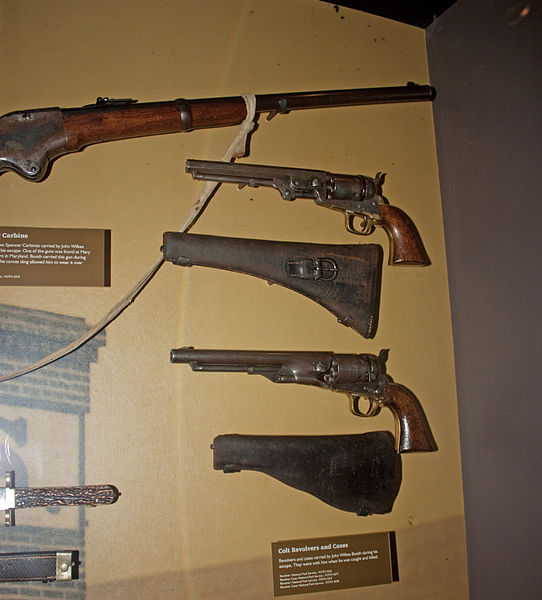
But that’s not really the point here – the point here is that revolvers
are easy to come by and might serve you better than a nearly-worthless
single-shot derringer. And according to the official story, you
definitely have access to at least two of them (pictured below).
There
are other things you might want to consider as well, such as not
committing the crime as John Wilkes Booth. You are, after all, a famous
stage actor, which means that you are also a wardrobe and makeup guy.
Because in your era, you and your contemporaries have to handle those
duties yourselves, so you travel with a couple large trunks full of
stuff like wigs and fake beards. You could easily don a convincing
disguise so as not to be easily recognized. Then you don’t have to worry
about getting out of the city alive; all you have to do is make it out
of the theater, quickly ditch the disguise, and then you can circle
around and rejoin the crowd at Ford’s without arousing any suspicion at
all.
And you do, after all, have a lot at stake.
Even if you manage to make an escape from DC, your lifestyle and career
will be distant memories. All the fame, all the female adoration, all
the success, all the wealth … it will all be gone if you commit the
crime as John Wilkes Booth. So you might want to put on a disguise. And
replace that derringer with a revolver or two. And maybe bring an
accomplice or two along for additional firepower. You have quite a few
co-conspirators to choose from.
You also might want
to reconsider whether Ford’s Theater is the best place to do this.
According to numerous historians, Lincoln has a bad habit of ignoring
advice from aides and strolling around Washington unescorted at times,
leaving him seriously vulnerable. That might make it a bit easier to
successfully pull this off.
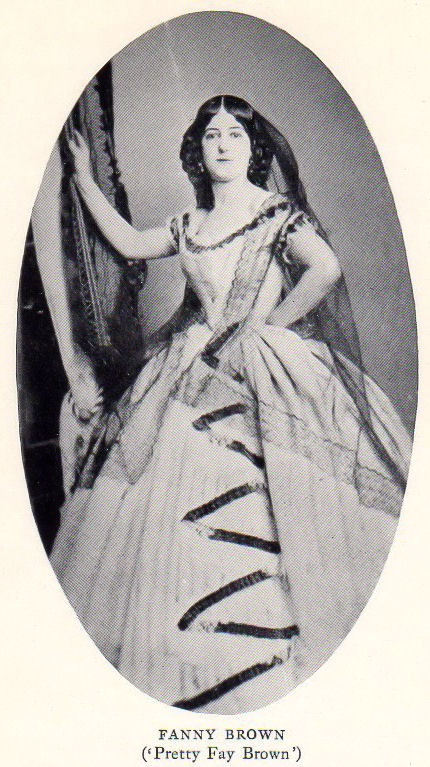
Fanny Brown, one of Booth’s many paramours
In
summary then, your best bet is probably to make the attempt
on Lincoln’s life when he is alone and unprotected. And you should
probably bring along some more impressive firepower, just in case. If
you are determined to do it in the theater, you should don a disguise
and bring along a couple other gunmen in case one or more of you are
killed or physically prevented from reaching the president. The dumbest
thing you could probably do would be to go it alone, as John Wilkes
Booth, and arm yourself only with a derringer. But I guess you can’t
argue with success … right?
Meanwhile, one of your
comrades-in-arms, Lewis Paine/Payne/Powell, has a difficult task ahead
of him as well. His goal is to kill Lincoln’s Secretary of State,
William Seward, who is recuperating at his stately manor in the heart of
DC after being severely injured in a fall from a horse-drawn carriage
just nine days earlier. Seward had suffered a broken lower jaw, a
fractured right arm, torn ligaments in his foot, and heavy bruising over
much of his body.
The 63-year-old secretary is
therefore physically vulnerable, but assassinating him is still not
going to be easy. For starters, Paine is going to have to gain access to
the estate. Then he’s going to have to find Seward without knowing the
layout of the home or which floor or which of the many rooms the
secretary is in. And he’s going to have to get past a lot of people,
because there are no less than eight other able-bodied adults in the
home, five of them men, two of whom are military personnel. And there
are readily accessible weapons in the home. And, as I may have
mentioned, there are armed patrols all over the city, and they are quite
capable of quickly responding to any signs of a disturbance at the
Secretary of State’s residence.
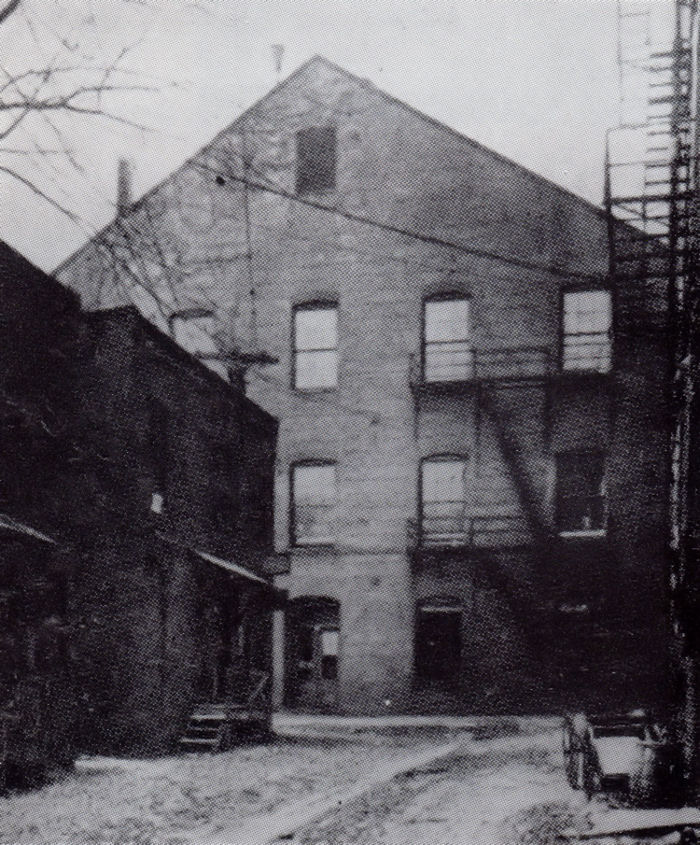
The rear view of Ford’s Theater and ‘Baptist Alley’
The
attack on Seward has been all but written out of our history books, but
in 1865 it was portrayed as an integral component of the plot
against Lincoln, particularly during the show trial of the alleged
conspirators. It is now mentioned only in passing, if at all. Which is
probably because the story doesn’t make a whole lot of sense.
In
the home are: William Seward, the injured Secretary of State; William
Bell, Seward’s black servant; Frederick Seward, William’s son as well as
his Assistant Secretary of State; Major Augustus Seward, another son
and a career Army officer (who will be promoted in a few weeks to
lieutenant colonel); Private George Robinson, Seward’s personal
attendant (who will be promoted to sergeant in a few weeks); Emerick
Hansell, a US State Department courier; Frances Seward, the secretary’s
wife (who will be dead very soon); Fanny Seward, his daughter (who will
be dead fairly soon); and, finally, the wife of one of the Seward sons.
Payne
of course is going it alone, just like Booth, for reasons that have
apparently never required an explanation. The five able-bodied men in
the house, at least a couple of whom are likely armed, will pose a
physical challenge. The three women will pose less of a physical threat,
but one or more of them are very likely to run out into the street to
summon any nearby patrols. And just the fact that there are so many
people in the way will make it extremely difficult for Powell to control
the situation.
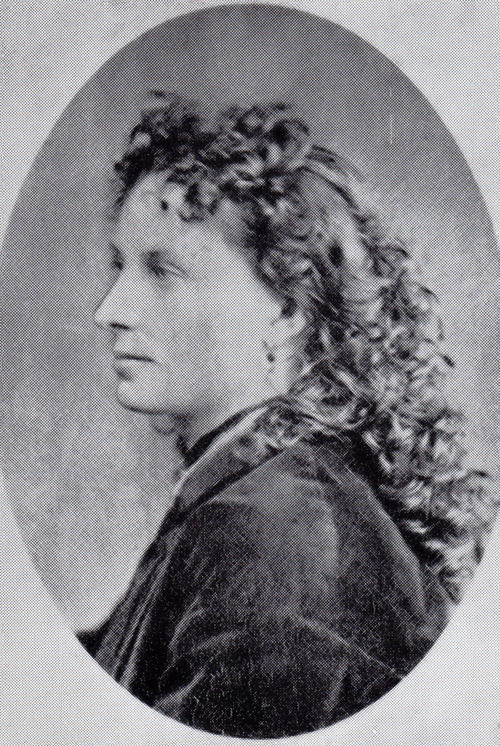 Another of Booth’s paramours, this one unidentified
Paine’s
mission is not unlike Booth’s; he must enter the building, work his way
past any resistance to get to his target, take out his target, work his
way back out of the building past any resistance, and then somehow find
his way out of Washington. But unlike Booth, Payne won’t have even a
single bullet to work with. Instead, he is going in armed only with a
bludgeon and a knife. And he’ll be coming out with nothing but the
clothes on his back.
Technically speaking, he will
be carrying a gun, but it doesn’t work and so is only useful as a
bludgeon. In a city overflowing with guns, Paine has chosen to bring one
that doesn’t work. Which means that, luckily for the Sewards, no one is
going to die.
Paine though is going to leave quite
a trail of destruction once he enters the estate, which sits just a
half-dozen blocks from Ford’s Theater. Frederick Seward will be left
gravely injured, with his head reportedly split open and his skull
fractured in two places. Major Augustus Seward will also receive severe
head injuries, with one report claiming that he was half scalped.
Private Robinson will also be seriously wounded, with deep stab wounds
to his chest. Emerick Hansell will receive at least one deep, very
serious chest wound as well. Fanny Seward will be wounded as well, in
some unspecified manner. And William Seward – who is lying in bed on his
back, unable to defend himself – will be brutally stabbed about the
head and neck, but will, despite his already weakened condition,
miraculously survive.
**********************************************************
It
is difficult to believe that the attack on Secretary of State Seward
ever took place at all. Lewis Paine supposedly gravely wounded six
people in hand-to-hand combat, four of them able-bodied men, and yet, as
photos taken soon after his arrest just days later reveal, he didn’t
have so much as a scratch on him. He supposedly left his hat, gun and
knife behind, creating a handy evidence trail, but why would he leave
his only weapons behind? He also allegedly left a bloodstained coat with
gloves and a fake moustache in the pocket in the woods just outside of
DC. Lewis Paine was apparently a very considerate attempted assassin.
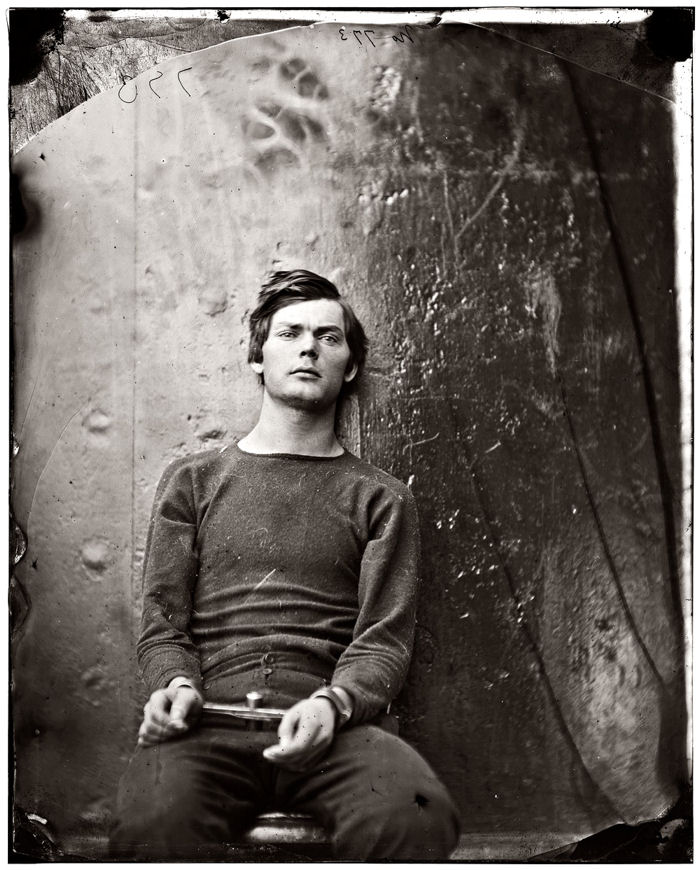
Lewis Paine, April 1865
The
descriptions of the conditions of the victims came from the first three
people to conveniently arrive at the crime scene: Secretary of War
Edwin Stanton, Secretary of the Navy Gideon Welles, and Surgeon General
Joseph Barnes. You know, just your typical first responders. None of
them reported seeing Augustus there. Stanton initially claimed that only
William Seward, Fred Seward and George Robinson were injured; Augustus
Seward, Emerick Hansell and Fanny Seward were later added to the victim
list, apparently so that the prosecution would have suitable witnesses.
It was an entire month before Fanny Seward came forward with her account
of the attack.
Augustus was later presented at
trial as both a victim of and an eyewitness to the attack – the attack
that very likely didn’t take place, in the home he wasn’t actually in at
the time. His testimony was wildly at odds with that of Robinson, with
both men claiming that they had been in the room and personally
witnessed the attack on William Seward. Not only did their accounts
significantly differ, but neither really explained why it was that with
the two of them in the room, and with Frederick and Hansell in the home
as well, they were unable to defend the secretary.
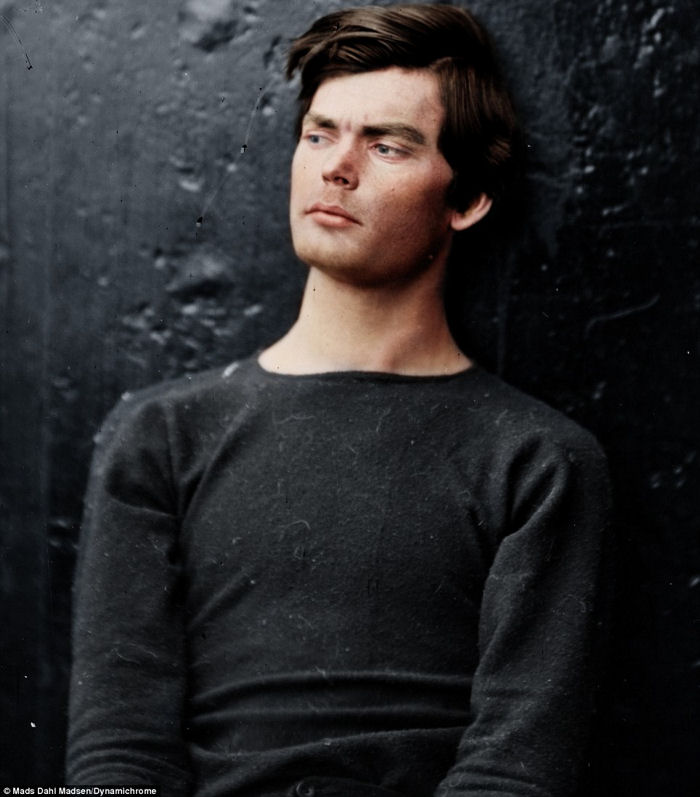
This remarkable image of Paine, captured in April 1865, has been lovingly colorized
It
is impossible to determine whether the alleged attack ever took place,
but it appears extremely unlikely. It does not seem logistically
possible for one barely armed man to have done what Paine is supposed to
have done. And it doesn’t seem physically possible for him to have done
so without sustaining a single visible injury. There is no tangible
evidence that Paine ever entered the home. The only ‘evidence’ that has
ever existed is the dubious (and conflicting) accounts told by the
alleged victims and by the high-ranking cabinet officials who just
happened to be first on the scene.
Let’s now
briefly review the key elements of this story: two assassins; three
targets; numerous people to get through to get to those targets;
numerous other people to get by to flee the scene; a city essentially
under martial law; and one – exactly one – bullet. Anyone see anything
wrong with that scenario?
… to be continued
http://centerforaninformedamerica.com/anatomy-of-a-presidential-assassination-part-ii/

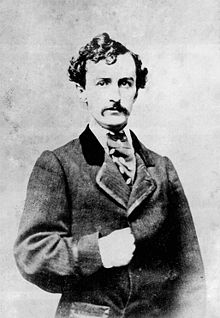 John Wilkes Booth, in a Masonic pose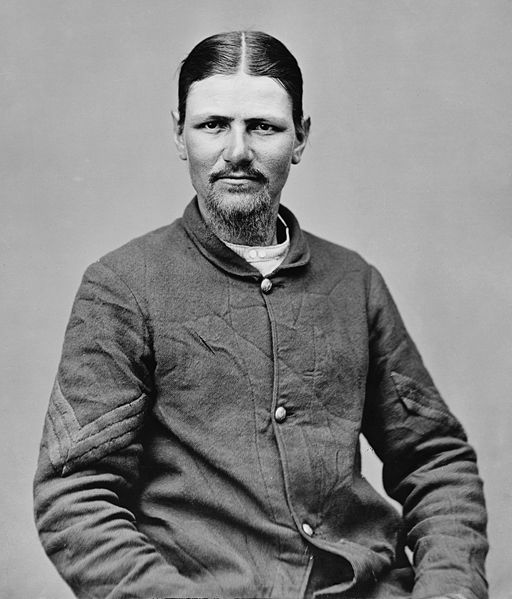

 Senator Preston King
 Lew Wallace